The announcement’s twenty entries#
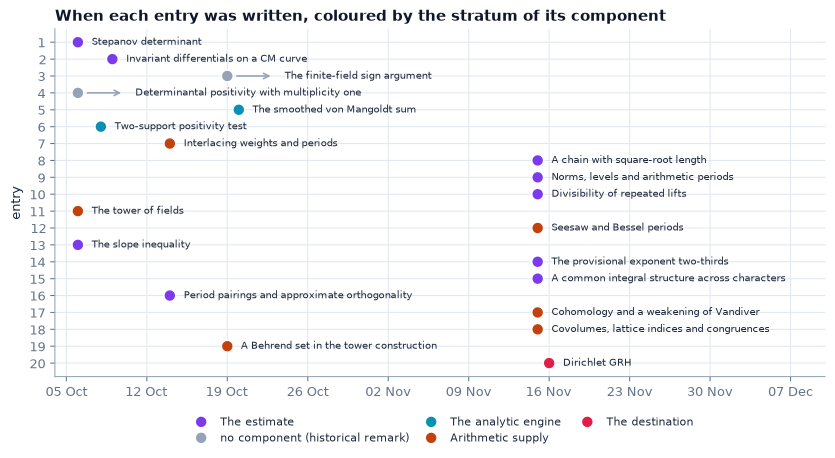
On pages 3 and 4 of the announcement the author lists, in twenty dated entries, the order in which the ideas occurred — from 6 October to 16 November 2026. The entries mix formulas, theorem claims, auxiliary problems and approaches later superseded. The reading project compared each with the archive; the column relation records how far that comparison goes, and the component model assigns 18 entries to components (2 are historical remarks without a component). The dates are those written in the announcement (a “+” there, rendered “onward” here, marks an idea pursued from that date on).
The entries#
# |
Written |
Topic · relation to the archive |
Component |
Assessment |
|---|---|---|---|---|
1 |
6 Oct |
Stepanov determinant |
The single-line entry records an origin of the argument. Its underlying function-field determinant is unspecified. |
|
2 |
9 Oct |
Invariant differentials on a CM curve |
The entry describes inert-prime divisibility of iterated derivatives. The argument for this displayed exponent was not identified in the selected source path. |
|
3 |
19 Oct onward |
The finite-field sign argument |
— |
The footnote compares a zero mode with an error bounded by iterated Parseval. Its objects and hypotheses differ from the Dirichlet L-function endpoint. |
4 |
6 Oct onward |
Determinantal positivity with multiplicity one |
— |
The short entry leaves W and S implicit. An exact theorem-to-type identification would require definitions of both. |
5 |
20 Oct |
The smoothed von Mangoldt sum |
The displayed zeta error has the exact ramp and the correction (1 + Euler’s constant)x. Character twists enter the level average. The sentence continues onto page 4. |
|
6 |
8 Oct |
Two-support positivity test |
The two indicator functions are a proposed model for a zero-free exponent. The final power-window criterion has a different statement. |
|
7 |
14 Oct |
Interlacing weights and periods |
A local Bessel model is constructed from two interlacing conditions. The announcement’s claim about determinant values 0 and 1 has further content. |
|
8 |
15 Nov |
A chain with square-root length |
The arithmetic rank specification puts m between one and two times x raised to 1/2 minus epsilon/16. The finite kernel recursion explains iteration. |
|
9 |
15 Nov |
Norms, levels and arithmetic periods |
One result relates a CM period to a logarithmic derivative. Another cancels a level volume against an index. The complete order-m cancellation requires more data. |
|
10 |
15 Nov |
Divisibility of repeated lifts |
A specific minor vanishes modulo a divisor and a lifted column has a higher-order remainder. Turning these local facts into the required global gain is an additional step. |
|
11 |
6 Oct |
The tower of fields |
The formal window ranges over fields specified by a fixing subgroup in a cyclotomic extension and by layer parameter e(x). |
|
12 |
15 Nov |
Seesaw and Bessel periods |
Conditional unfolding identifies a theta-lift period with an integral. A middle-step volume identity is independent of the admissible character. A full iterated comparison is a stronger assertion. |
|
13 |
6 Oct |
The slope inequality |
The Euclidean lattice model bounds the slope of an injectively mapped source by the maximal target slope plus the logarithm of the map bound. Identification of the particular period lattice is separate. |
|
14 |
15 Nov |
The provisional exponent two-thirds |
The author describes a barrier for an earlier estimate. The endpoint reads a one-half-plus-loss exponent. The earlier barrier is not derived in this comparison. |
|
15 |
15 Nov |
A common integral structure across characters |
The final deduction imposes local and global controls on the same family. A precise comparison with the gcd in the historical description remains open. |
|
16 |
14 Oct |
Period pairings and approximate orthogonality |
Unfolding relates a Poincare-series pairing to an integral of periods. The later host comparison turns suitable bounds into an estimate for the weighted prime sum. |
|
17 |
15 Nov |
Cohomology and a weakening of Vandiver |
The window requires finite lengths and an aggregate weighted bound. Further implications for individual K-groups are conjectural comments in the announcement. |
|
18 |
15 Nov |
Covolumes, lattice indices and congruences |
A covolume bound is an explicit premise of the automorphic assembly. The local congruence lemma gives a representative higher-order equality. |
|
19 |
19 Oct |
A Behrend set in the tower construction |
Encoding a populated integer sphere in a large base excludes short affine relations and controls intersections with short orbits. |
|
20 |
16 Nov |
Dirichlet GRH |
The source declares that zeros of every Dirichlet L-function in the open critical strip are on the critical line. This entry records source-statement correspondence. |
Summary#
Relation |
Entries |
|---|---|
Supporting comparison |
9 |
Historical motivation |
2 |
Historical calculation |
2 |
Quantitative comparison |
2 |
Historical analogy |
1 |
Formula matched |
1 |
Mathematical statement matched |
1 |
Intermediate strategy |
1 |
Endpoint statement matched |
1 |
Component |
Entries |
|---|---|
20 |
|
5 |
|
6 |
|
14, 16 |
|
1, 2, 8, 9, 10, 13, 15 |
|
11, 17 |
|
19 |
|
7, 12, 18 |
Two observations matter for the architecture. First, the entries that can be matched to a formula or statement of the archive (the smoothed von Mangoldt sum, the slope inequality, Dirichlet GRH) are few; most are supporting or quantitative comparisons, where the archive contains a related but more specific statement. Second, the provisional exponent two-thirds of entry 14 is an intermediate strategy: the archive’s estimate has exponent \(\tfrac12+(e_D+e_L+7)\varepsilon\), and how the earlier barrier was overcome is not derived in the comparison.