The arithmetic supply#
Arithmetic supply Galois representations, theta lifts and Iwasawa-type cohomology bounds that are meant to produce the families on which a prime sum is small.
This stratum is where the deep arithmetic lives: Galois representations attached to automorphic
representations, theta correspondences, and a bound for Galois cohomology along cyclotomic towers
that the announcement describes as a weakening of Vandiver’s conjecture. It is also where the two
premises of the second verified cut, TopG and VWinAt ψ 401, are produced. Most of it is, in the
imported record, source-read rather than separately replayed; the kernel-checked steps are
implications with explicit premises:
Analytic and Behrend landmarks (38 original modules):
Formalism.FrobeniusOrbits.ThickExists.noRel_image,Formalism.FrobeniusOrbits.hostThickExists. Premises: Separate hypotheses for each selected result, given in the theorem table. Conclusion: Pole data for finite character families and a zero-free criterion from a uniform window bound. Relation avoidance on digit spheres and a quantitative large-set construction.Exceptional-twist windows (32 original modules):
UpperTheory.V.Win.window1,UpperTheory.V.Win.window. Premises: Finite exceptional sets and the stated scale inequalities. Conclusion: A whole interval simultaneously controls every exceptional twist.Auxiliary primes and their twists (293 original modules):
QH.pairEx. Premises: A positive integer M, 0<ε<1/52 and A≥1. Conclusion: Every sufficiently large Y admits a pair of primes with the required congruences, smoothed prime-sum and derivative bounds on [Y,Y^A], and finite zero-free boxes for the specified nontrivial quadratic twists.Arithmetic window assembly (659 original modules):
UpperTheory.V.Win.thmBab_of. Premises: An exponent satisfying LemmaK, the fixed odd-prime tower bounds FixedIn, and the uniform two-adic tower bound TwoIn. Conclusion: One record of constants K gives the joint arithmetic window ThmBab K Ct for every Ct≥1.Inputs to the arithmetic tower window (1,111 original modules):
UpperTheory.V.PropA.aBound_of_isTower,UpperTheory.V.Win.thmBab_of_lemmaK. Premises: The exact duality, finiteness, tower, Ferrero–Washington and growth premises specified for each theorem. Conclusion: A cohomological tower bound and a simultaneous choice of arithmetic windows.
11 · The cohomological window#
Arithmetic supply ◐ Partly checked VWinAt ψ 401
The gist
On a whole interval \([Y,Y^2]\), weighted lengths of locally trivial Galois cohomology of twisted modules are at most \(\sqrt{\exp(x^{\varepsilon})}\), uniformly over the relevant fields.
Statement (paraphrase of the archive’s Lean statements in standard notation):
An \(\ell\)-adic determinant estimate gives at most \(R\) centers; each center accounts for at most one exceptional twist \(h\le Z\) (ultrametric separation). Finitely many exceptional twists forbid at most \(R\) logarithmic intervals \([a,Ba)\).
A real-variable induction (window1) finds \([y,2y]\) avoiding all of them with \(y\ge U/(2^{R+2}B^R)\); exponentiating gives \([Y,Y^2]\) with \(X^{1/J}\le Y\), \(J=4(2B)^R\). The bound on the sums comes from four counting cases, a Ferrero–Washington input and descent.
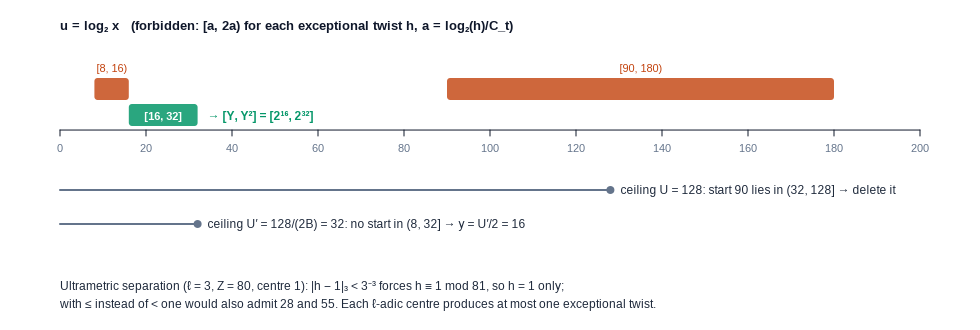
Fig. 11 One interval survives all exceptional twists. Computed with the induction of UpperTheory.V.Win.window1 on the book’s example: forbidden logarithmic intervals [a, B a) for a = 8, 90 with B = 2 inside [0, 128]; the recursion lowers the ceiling 128 -> 32 and returns [16, 32], i.e. [Y, Y^2] = [2^16, 2^32].#
Lean declaration (archive, pinned at the mirror commit) |
Note |
|---|---|
the cohomological window (definition) |
|
weighted lengths of local–global kernels (definition) |
|
the window from the Galois row |
|
combine the cohomology counts |
|
Choose one set of tower constants |
|
From a finitely generated tower to two length bounds |
|
Assemble the arithmetic tower window |
Verification. ◐ Partly checked Some of the component’s named declarations are kernel-checked; the producers of its remaining inputs are source-read.
Status in the imported record (20 November 2026, 23:51 UTC). window1 and window (the interval selection) passed at the archive pin, and so did the tower deductions thmBab_of (one record of window constants for every cutoff Ct ≥ 1 from LemmaK, FixedIn and TwoIn), aBound_of_isTower (a tower cohomology bound from duality and finiteness premises) and thmBab_of_lemmaK, each with its premises explicit. Those premises (Poitou–Tate and local Tate duality, local finiteness, Ferrero–Washington, LemmaK) and the counting cases are source-read here.
What remains to check. Uniform cohomological bound: track finiteness and absolute constants from the four counting cases to the finite prime sums on the claimed windows.
Blueprint. 25 of the reading project’s declarations belong to this component (3 kernel-checked at the archive pin, 2 inside a checked closure, 20 source-read); see 11 · The cohomological window.
Receives from 13 · The Galois row: Row0b → window (vwin_of_row); from 12 · Auxiliary primes and Behrend towers: prime pairs, tower (WinPair / hostThickExists).
Delivers to 10 · Hosts for every character: VWinAt ψ 401 (UpperTheory.Top.VWinAt).
Verified cuts: this component lies outside both machine-checked implications (see The two verified cuts).
Announcement entries: 11 (6 Oct: The tower of fields); 17 (15 Nov: Cohomology and a weakening of Vandiver) — see The announcement’s twenty entries.
The quantity that is bounded#
For a number field \(E\) in a prescribed family, a prime \(\ell\) and a twist \(h\), let \(s_{\ell,h}(E)\) be
the \(\mathbf Z_\ell\)-length of the locally trivial part of \(H^1\) of \(E\) with coefficients in
\(\mathbf Q_\ell/\mathbf Z_\ell\) twisted by the \(h\)-th power of the inverse cyclotomic character (the
archive’s shaLen). The predicate VVle E t B asks that all these lengths be finite for
\(1\le h<t\) — a separate clause, because converting an extended natural number to a natural number
sends \(\infty\) to \(0\) in Lean — and that \(\sum_{\ell\in S}\log\ell\sum_{1\le h<t}s_{\ell,h}(E)\le B\) for
every finite set of primes \(S\). The window VWinAt ψ 401 asks for this with \(t=\lfloor x^{401}\rfloor\)
and \(B=\sqrt{\exp(x^{\varepsilon})}\), at every real \(x\) of an interval \([Y,Y^2]\), uniformly over the
fields attached to \(\psi\), the layer \(e(x)\) and the auxiliary primes \(q,d\). The bound is enormous;
what matters is that it is uniform, finite, and sub-exponential in the scale that the
estimate stratum can absorb.
How many twists can be expensive#
In one tower the relevant length is a cokernel length for a twisted operator, and an \(\ell\)-adic determinant estimate supplies centres \(s_1,\dots,s_{R'}\), the same for every twist \(h\) and every layer \(m\), with
A twist \(1\le h\le Z\) is exceptional if \(|h-s_i|_\ell<\ell^{-k}\) for some \(i\), where
\(k=\lfloor\log_\ell Z\rfloor\). Each centre accounts for at most one exceptional twist: two of them would
satisfy \(\ell^{k+1}\mid a-b\) with \(0<|a-b|<Z<\ell^{k+1}\). So there are at most \(R\) exceptions however
large \(Z\) is — this integer core is proved in this repository’s Lean file Atlas/Separation.lean
(see Ultrametric separation: Atlas/Separation.lean). The strict inequality matters: for \(\ell=3\), \(Z=80\) and centre \(1\) only
\(h=1\) is exceptional, while with “\(\le\)” the twists \(28\) and \(55\) would also qualify
(One interval for all exceptional twists: window1 and ultrametric separation). The total count \(R=R_0(M)+\sum_{\ell\in B'}R_\ell(L_\ell)\) is fixed before the
auxiliary primes are chosen; the rank bounds behind it use the archive’s Ferrero–Washington
formulation.
Why one interval survives#
Put \(\eta=\varepsilon/(2C_K)\), \(u=\log x\), \(a=(\log h)/C_t\) and \(B=C_t/\eta\) with \(C_t=401\). An exceptional
twist \(h\) is harmless at \(x\) if \(h\le x^{C_t}\Rightarrow h\le x^{\eta}\), and this fails exactly for
\(u\in[a,Ba)\). The real-variable lemma UpperTheory.V.Win.window1 (kernel-checked) finds \([y,2y]\)
inside \([0,U]\), \(U=\log X\), missing all \(R\) forbidden intervals, with \(y\ge U/(2^{R+2}B^R)\): if no
start lies in \((U/2B,U]\) take \(y=U/2\); otherwise delete one such start and recurse below
\(U/2B\). Exponentiating gives \([Y,Y^2]\subset[X^{1/J},X]\) with \(J=4(2B)^R\). In the computed example
(\(C_t=2\), \(\eta=1\), \(X=2^{128}\), exceptional twists \(2^{16}\) and \(2^{180}\)) the induction deletes
the start \(90\), lowers the ceiling from \(128\) to \(32\) and returns \([Y,Y^2]=[2^{16},2^{32}]\); a
randomized test of the lower bound is in One interval for all exceptional twists: window1 and ultrametric separation.
On the surviving interval, unexceptional twists have valuations at most \(\lfloor\log_\ell Z\rfloor\), and each exceptional twist that is still active is small (\(h\le x^{\eta}\)) and is handled by a fixed-layer estimate; the choice of \(\eta\) keeps that secondary cost at \(x^{O(\varepsilon)}\). The positive part, the negative part and the prime \(2\) are then evaluated on the same field at the same \(x\), and an elementary comparison absorbs their sum into \(\sqrt{\exp(x^\varepsilon)}\).
Where the bound itself comes from#
The window is produced through the call vwin_of_row from the Galois row of 13 · The Galois row.
Along the way, tower estimates (for each prime \(\ell\), lengths controlled away from finitely many
centres and in terms of a fixed layer) are combined into one record of constants valid for every
cutoff exponent, and counting cases I, II, III and V bound the lengths over arbitrary finite sets of
coefficient primes. One of the reading project’s itineraries follows exactly this path; each step is
listed with its contract and tier (the premises of the checked steps — global Poitou–Tate duality,
local finiteness and local Tate duality, a Ferrero–Washington rank bound, a uniform exponent for a
reference layer — are among the source-read steps):
Follow a singular twist and an arbitrary finite prime sum. Which bound controls a twist of unbounded abstract length, and how can one estimate work over every allowed finite set of coefficient primes?
Produce the four counting bounds —
UpperTheory.V.HV.DescentVanishingReductions.vwin_of_hypotheses_H_E_alt◇ source-read · HypothesesH′ imply VWin. (component 11, The cohomological window)Supply the absolute bound for the reference layer —
UpperTheory.V.ZK.lemmaK_litN_alt◇ source-read · One real exponent bounds the logarithm of the order of \(H^2(G_{L,S},\mathbb Z_\ell(e+1))\) over all eligible fields, coefficient primes and positive twists. Each such group is finite. (component 11, The cohomological window)Combine the cohomology counts —
UpperTheory.V.HV.Core.of_four_alt◇ source-read · Rank-N input, an existential K bound and CountI, CountII, CountIII, CountV imply VWin. (component 11, The cohomological window)Assemble the arithmetic tower window —
UpperTheory.V.Win.thmBab_of_lemmaK✓ kernel-checked · One package of constants works at every cutoff exponent Ct ≥ 1. (component 11, The cohomological window)From a finitely generated tower to two length bounds —
UpperTheory.V.PropA.aBound_of_isTower✓ kernel-checked · For each prime and eligible tower, ABound consists of a bound away from finitely many centres and a bound in terms of a fixed layer. (component 11, The cohomological window)Control exceptional twists by the fixed layer —
UpperTheory.V.PropA.aBound_of_descends⊂ in checked closure · The lengths are controlled by at most R ℓ-adic centres. For all twists they are also bounded by the fixed-layer H² length plus R times the excess layer index. (component 11, The cohomological window)Choose one set of tower constants —
UpperTheory.V.Win.thmBab_of✓ kernel-checked · There exists a single BConst K such that every Ct ≥ 1 satisfies ThmBab K Ct. (component 11, The cohomological window)Case I gives one bound across coefficient primes —
UpperTheory.V.Z.J.count_i_of_printed_bound_k_kato_automorphy◇ source-read · Away from the exceptional set, when ℓ−1 does not divide twice the twist, the sum over every allowed finite set of coefficient primes obeys one polynomial bound. (component 11, The cohomological window)A nonzero integer controls one character orbit —
UpperTheory.V.Z.J.propGK_of_numberU3U_of_oneCharU◇ source-read · For a fixed imaginary quadratic field, twist, character kernel and admissible auxiliary prime, one nonzero integer gives a logarithmic size bound and simultaneous valuation bounds at the other eligible primes. (component 11, The cohomological window)Convert the joint window into VWin —
UpperTheory.V.HV.vwin_of_counts◇ source-read · The tower window, sign bounds and five counting inputs yield VWin, the cohomology estimate for each primitive character at cutoff exponent 401. (component 11, The cohomological window)Reuse the tower interval for the positive part —
UpperTheory.V.HV.jointWin_of_counts◇ source-read · For each eligible choice of character and parameters, one interval satisfies both the tower and positive-part bounds at every point. (component 11, The cohomological window)Combine the two prime sums at a point —
UpperTheory.V.HV.pointHV_of_counts◇ source-read · After the character and layer indices are fixed, one polynomial bound controls the positive cohomological sum on eligible hosts, with an additive multiple of the layer budget. (component 11, The cohomological window)Add contributions inside the exceptional set —
UpperTheory.V.HV.sumIn◇ source-read · For fixed character, exceptional coefficient prime and layer index, the positive-part sum at that prime is at most (Nt)^C + C·B when the fixed layer satisfies its budget B. (component 11, The cohomological window)Bound the sum over arbitrary finite sets of other primes —
UpperTheory.V.HV.sumOut◇ source-read · Choose a common exponent and two auxiliary primes before the host. The positive-part sum over every allowed finite set of nonexceptional odd primes is at most (Nt)^C. (component 11, The cohomological window)
This is the precise place to compare the announcement’s “weakening of Vandiver” with the mathematics: the window bounds sums of lengths, for a selected family of fields and a bounded range of twists. Positive finite lengths are compatible with it, and the announcement’s further remarks about individual \(K\)-groups would require additional theorems.
12 · Auxiliary primes and Behrend towers#
Arithmetic supply ✓ Kernel-checked at the archive pin QH.pairEx · hostThickExists
The gist
Two auxiliary primes with prescribed congruences and square-root prime-sum bounds for their quadratic twists, and an additive-combinatorial (Behrend) choice of the tower.
Statement (paraphrase of the archive’s Lean statements in standard notation):
With \(z=Y^{\varepsilon/5}\) the primes satisfy \(z/2<\log q\le z\) and \(z(\log Y)^2/2<\log d\le z(\log Y)^2\); \(d+1\) is divisible by \(q\) and by every odd prime up to \(z\). They are chosen sequentially from positive shares of candidates, and may change with \(Y\).
Behrend: integer vectors of fixed norm, encoded in a large base, avoid short affine relations because a line meets a sphere at most twice.
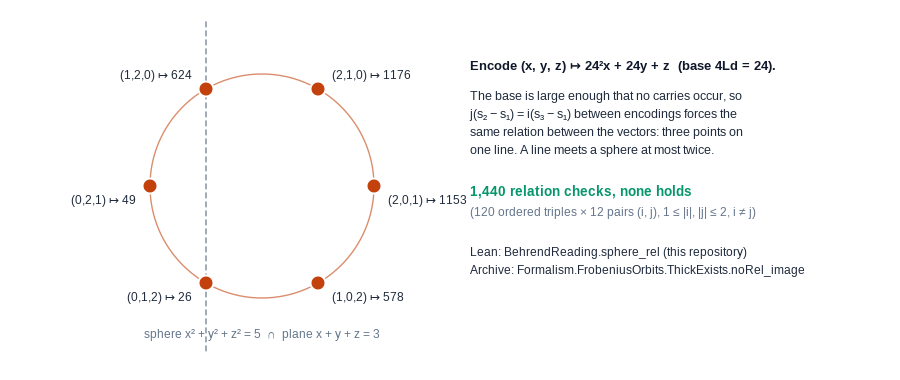
Fig. 12 A Behrend digit sphere. Computed: the vectors of {0,1,2}^3 with squared norm 5 are the six permutations of (0,1,2); they lie on the circle where the sphere meets the plane x+y+z = 3. Their base-24 encodings avoid every relation j(s2-s1) = i(s3-s1) with 1 <= |i|,|j| <= 2, i != j: 1,440 checks.#
Lean declaration (archive, pinned at the mirror commit) |
Note |
|---|---|
digit spheres avoid short relations |
|
Verification. ✓ Kernel-checked at the archive pin Named declarations passed type, transitive-axiom (only propext, Classical.choice, Quot.sound) and kernel-replay checks at Lean 4.33.1.
Status in the imported record (20 November 2026, 23:51 UTC). QH.pairEx passed in its 293-module closure; the Behrend landmarks (sphere_rel, noRel_image, hostThickExists) passed in the 38-module landmark closure.
What remains to check. How the chosen primes feed the window for a fixed target character.
Blueprint. 2 of the reading project’s declarations belong to this component (1 kernel-checked at the archive pin, 1 motivation); see 12 · Auxiliary primes and Behrend towers.
Delivers to 11 · The cohomological window: prime pairs, tower (WinPair / hostThickExists).
Verified cuts: this component lies outside both machine-checked implications (see The two verified cuts).
Announcement entries: 19 (19 Oct: A Behrend set in the tower construction) — see The announcement’s twenty entries.
What the two primes buy#
The kernel-checked theorem QH.pairEx (scope “Auxiliary primes and their twists”, 293 original modules) assumes: A positive integer M, 0<ε<1/52 and A≥1. It concludes: Every sufficiently large Y admits a pair of primes with the required congruences, smoothed prime-sum and derivative bounds on [Y,Y^A], and finite zero-free boxes for the specified nontrivial quadratic twists.
The primes \(q\) and \(d\) enter the definition of the fields over which the cohomological window is
taken (through the admissibility condition WinPair) and the host fields. The twists of a
character modulo \(M\) by the quadratic characters at \(q\), at \(d\), or at both, have square-root
prime-sum bounds on \([Y,Y^A]\); bounds of this shape are what the finite comparison assumes for the
characters it discards, and how exactly the chosen primes feed the window for a fixed target
character is listed as still to be checked (card above). The choice is sequential: a counting theorem gives a positive share of
admissible first primes, and for each of them a positive share of second primes; taking the share
parameter \(\tfrac12\) leaves at least one choice at each stage. Changing \(Y\) may change both primes,
hence the twisted characters; applying the analytic criterion to a fixed \(L\)-function still
requires the host construction on arbitrarily late windows.
The Behrend set in the tower#
The choice of the tower uses an additive-combinatorial construction. Take the integer vectors in
\(\{0,\dots,d-1\}^S\) of a fixed squared norm and encode them in base \(4Ld\). A relation
\(j(s_2-s_1)=i(s_3-s_1)\) between encodings, with \(1\le|i|,|j|\le L\) and \(i\neq j\), forces the same
relation between the vectors, because the large base prevents carries; and three distinct points
of a sphere cannot satisfy it, because a line meets a sphere at most twice. In the computed example
(\(S=3\), \(d=3\), \(L=2\), squared norm \(5\)) the sphere consists of the six permutations of \((0,1,2)\),
their base-\(24\) encodings are 26, 49, 578, 624, 1153, 1176, and all 1,440
relations fail (The Behrend digit sphere). Choosing the most populous sphere gives the quantitative lower bound
of hostThickExists, and the property HostThickOrbit bounds the intersection of a translate
with a short segment of a high-order orbit by two points. The archive’s theorems sphere_rel,
noRel_image and hostThickExists are kernel-checked; this repository’s independent proof of the
sphere lemma is BehrendReading.sphere_rel (Teaching files from the reading project).
13 · The Galois row#
Arithmetic supply ◇ Source-read Row0b
The gist
For regular algebraic polarized cuspidal \(\pi\) on \(\mathrm{GL}_a\) over a CM field, a continuous semisimple \(\ell\)-adic representation whose Frobenius polynomials match the Satake parameters of \(\pi\).
Statement (paraphrase of the archive’s Lean statements in standard notation):
The construction starts from a geometric seed and a high-rank theta lift (tLiftK), treats a restricted case, removes the prescribed polarization by twisting, and descends from infinitely many quadratic CM extensions \(K=E(\sqrt{-p})\) by index-two patching of trace identities.
The exported row also records local–global compatibility away from \(\ell\) and crystalline/de Rham comparisons above \(\ell\). A rank-one example shows that the hypotheses are inhabited.
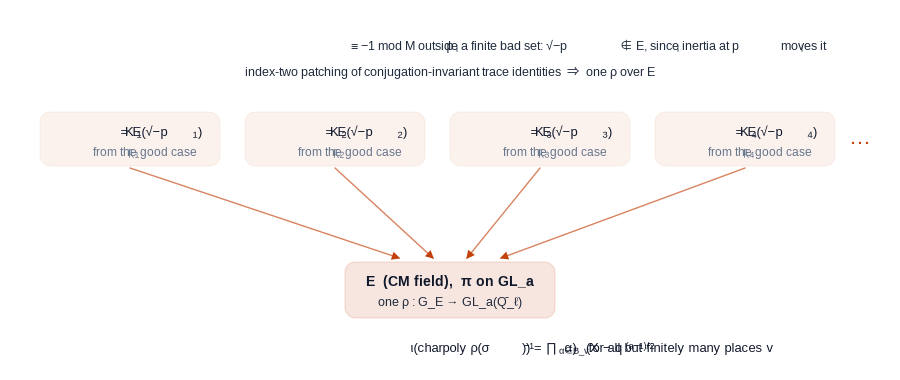
Fig. 13 The Galois row by quadratic descent (schematic). Schematic: representations r_K over infinitely many quadratic CM extensions K = E(sqrt(-p)) are patched to one rho over E whose Frobenius polynomials match the Satake parameters of pi.#
Lean declaration (archive, pinned at the mirror commit) |
Note |
|---|---|
the local–global Galois row (definition) |
|
producer of the row |
|
Galois representations from theta lifting |
|
theta-lift existence at high rank (theorem) |
|
quantifiers of the theta lift (definition) |
|
weight-one geometric realization |
Verification. ◇ Source-read Statement and proof term located at pinned source lines and read; not replayed as a named declaration by the reading project’s audit. It is part of the complete proof, whose replays are listed in the ledger.
Status in the imported record (20 November 2026, 23:51 UTC). Source-read against 62 passages in 36 modules; included in the externally reported full build; not separately replayed by this audit.
What remains to check. Unfold the row, the local normalization convention and the theta-lift producer together; check all quantified places, twists and weight restrictions.
Blueprint. 6 of the reading project’s declarations belong to this component (6 source-read); see 13 · The Galois row.
Delivers to 14 · Seven inputs at the decisive call: Row0b (two fields) (everyCharacter_of_row); to 11 · The cohomological window: Row0b → window (vwin_of_row).
Verified cuts: this component lies outside both machine-checked implications (see The two verified cuts).
Inputs and outputs#
Fix a CM field \(E\), an algebraic closure \(\Omega/E\), a prime \(\ell\), an isomorphism \(\iota:\overline{\mathbf Q}_\ell\simeq\mathbf C\) and \(a\ge1\). An input is a cuspidal automorphic representation \(\pi\) of \(\mathrm{GL}_a(\mathbf A_E)\) — in Lean a nonzero, invariant, irreducible space of cusp forms — which is regular algebraic (at each embedding the infinitesimal-character exponents are distinct and lie in \(\tfrac{a-1}2+\mathbf Z\)) and polarized (a Hecke character \(\chi\) of the maximal totally real subfield \(E^+\) with the right sign at the real places, and an equivariant nondegenerate pairing between \(\pi\otimes(\chi\circ N_{E/E^+})^{-1}\) and \(\pi\)).
The output is a continuous semisimple \(r:G_E\to\mathrm{GL}_a(\overline{\mathbf Q}_\ell)\), an integer \(w_\pi\) and Hodge–Tate multisets \(H_\tau\) with \(H_{\tau\circ c}=w_\pi-H_\tau\), such that for all but finitely many places \(v\), with \(q=Nv\) and \(\sigma\) a Frobenius lift,
where \(B_v\) is the (unique) multiset of Satake parameters of \(\pi_v\), characterized through the eigenvalues of the spherical Hecke operators on a nonzero spherical vector. The exported row also records local–global compatibility at \(v\nmid\ell\) under stated conditions on the local parameter, and crystalline, de Rham and potentially semistable comparisons above \(\ell\).
The construction, as the source organizes it#
The producer galoisLocalGlobalStrong_recParameter feeds two inputs into the construction: a
geometric seed (geoOne_holds, built from a holomorphic Lefschetz formula) and a theta-lifting
theorem (tLiftK, with hypotheses on Hermitian and skew-Hermitian spaces, characters and weights).
It then climbs through three domains: a restricted case with a prescribed polarizing character and
extra field and place conditions; the general “good” case, reached by twisting \(\pi\) by a Hecke
character to meet the prescription and untwisting the Galois side; and the general case, reached by
quadratic descent. For the last step one takes primes \(p\equiv-1\) modulo a modulus \(M\) collecting
the finitely many bad primes, adjoins \(\sqrt{-p}\) — inertia at \(p\) moves it, so \(K=E(\sqrt{-p})\) is a
new quadratic CM extension — base-changes \(\pi\) to \(K\), applies the good case, and patches the
resulting \(r_K\) by an index-two theorem on conjugation-invariant trace identities that agree on
pairwise intersections. The result is one \(\rho\) over \(E\) whose restriction to \(G_K\) is \(r_K\) for all
but finitely many \(K\); for each place \(v\) a good \(K\) (depending on \(v\)) transfers the Frobenius
formula to \(\rho\). A rank-one example with the constant cuspidal line shows that the hypotheses are
inhabited and that the polarization sign matters.
What this component is, and is not#
The row is stated for all regular algebraic polarized cuspidal \(\pi\) on \(\mathrm{GL}_a\) over CM fields; it is the input that both the cohomological window and the automorphic assembly consume. Its verification status is the one on the card above. A proof of this local–global statement would still leave the global estimates of the other strata to be justified, and conversely a mathematical assessment of the theta lift, the geometric seed, base change and trace patching is a larger task than reading their types.
14 · Seven inputs at the decisive call#
Arithmetic supply ◇ Source-read every_character_of_literature_of_vWin
The gist
Unitary-group and local theta packages, agreement of theta integrals, local matching, a covolume bound, local Langlands parameters and the window: the seven arguments of the arithmetic theorem.
Statement (paraphrase of the archive’s Lean statements in standard notation):
everyCharacter_of_row fills two fields of the literature record with the same Galois row, adds the existence of local Langlands parameters, and obtains the cohomological window from the same row. The next line supplies the row by name, so the half-plane theorem has no explicit premise.
A name such as published_results_eigen is where to start verifying what the term establishes, not an explanation of it.
Lean declaration (archive, pinned at the mirror commit) |
Note |
|---|---|
the half-plane theorem from one row |
|
closed half-plane assembly |
|
|
assemble the automorphic inputs |
|
seven inputs for every character |
Verification. ◇ Source-read Statement and proof term located at pinned source lines and read; not replayed as a named declaration by the reading project’s audit. It is part of the complete proof, whose replays are listed in the ledger.
Status in the imported record (20 November 2026, 23:51 UTC). Source-read; included in the externally reported full build; not separately replayed by this audit.
What remains to check. Source comparison of each named input with the mathematics it is meant to encode.
Blueprint. 16 of the reading project’s declarations belong to this component (16 source-read); see 14 · Seven inputs at the decisive call.
Receives from 13 · The Galois row: Row0b (two fields) (everyCharacter_of_row).
Delivers to 9 · The geometric family and the theta chain: definite-side data (every_character_of_theta_integrals_local_matching).
Verified cuts: this component lies outside both machine-checked implications (see The two verified cuts).
Announcement entries: 7 (14 Oct: Interlacing weights and periods); 12 (15 Nov: Seesaw and Bessel periods); 18 (15 Nov: Covolumes, lattice indices and congruences) — see The announcement’s twenty entries.
The seven groups of hypotheses#
The theorem UpperTheory.Lit.every_character_of_theta_integrals_local_matching takes exactly
7 arguments, as recorded in the blueprint:
P : UnitaryGroupThirdPlaceHypotheses— the unitary-group hypotheses at an auxiliary place (the eigenvalue package)F : ThetaLocalInputs— the local theta inputs (the local theta package)hA : ThetaIntegralsAgree— agreement of theta integralshM : LocalMatching— local matchinghX : CovolumeBoundOfX— a covolume boundhL : RecTExists— existence of local Langlands parametershV : VWin— the cohomological window
From them it constructs a nonempty package of definite-side data (test vectors, grids of Fourier
coefficients, linked bundles) and a “Green” input about characters of finite general linear groups,
and passes them to every_character_of_green_v_win, which fixes the window width \(3/2\), obtains the
primitive half-plane statement through the second verified cut’s chain (TopG from the family
shape, hosts from the window) and descends to all characters.
How the type loses its premises#
UpperTheory.FinalTheorems.everyCharacter_of_row takes one hypothesis, the Galois row Row0b
(with the archive’s local-parameter convention). It inserts that same term into two fields of the
literature record OpenLiteratureStatements (whose fields are a row, a local-parameter
statement and a row again), adds the existence of local Langlands parameters, and obtains the
cohomological window VWin from the same row. The next line, everyCharacter, supplies the row by
name — galoisLocalGlobalStrong_recParameter — so the half-plane theorem, and with it the five
exports, have no explicit arithmetic premise in their types.
That is a statement about types, not about mathematics. Names such as published_results_eigen,
published_results_first or theta_integrals_agree_and_local_matching_of_literature are where to
start verifying what the supplied terms establish; they are not explanations. Two of the five open
audit questions of the reading project sit exactly here: the source comparison of the Galois input,
and the existence of nonempty compatible data for one geometric family (The verification ledger).