The Behrend digit sphere#
In the choice of the tower (12 · Auxiliary primes and Behrend towers) the archive uses Behrend’s construction: integer vectors of fixed norm, written as digits in a large base, give a large set of integers without short affine relations. This notebook recomputes the atlas’s six-point example with its exhaustive check, verifies the two facts the proof combines (no carries; a line meets a sphere at most twice), and runs a larger exhaustive check.
The example#
Take the vectors of \(\{0,1,2\}^3\) with squared norm \(5\) and encode \((x,y,z)\mapsto 24^2x+24y+z\) (base
\(4Ld=24\) for \(L=2\), \(d=3\)). The claim is that no three distinct encodings satisfy
\(j(s_2-s_1)=i(s_3-s_1)\) with \(1\le|i|,|j|\le2\) and \(i\neq j\); rhlib.behrend_example checks every ordered
triple and coefficient pair (it raises on a relation).
S, d, L, norm = fb['S'], fb['d'], fb['L'], fb['norm']
pts, enc, checks = rhlib.behrend_example(S=S, d=d, L=L, norm=norm)
print("points    :", pts)
print("encodings :", enc)
print(f"checks    : {checks:,}  (= {len(pts) * (len(pts) - 1) * (len(pts) - 2)} ordered triples × "
      f"{(2 * L) * (2 * L - 1)} coefficient pairs)")
assert [list(p) for p in pts] == fb['points'] and enc == fb['encodings'] and checks == fb['checks']
assert 4 * L * d == fb['base'] and checks == len(pts) * (len(pts) - 1) * (len(pts) - 2) * (2 * L) * (2 * L - 1)
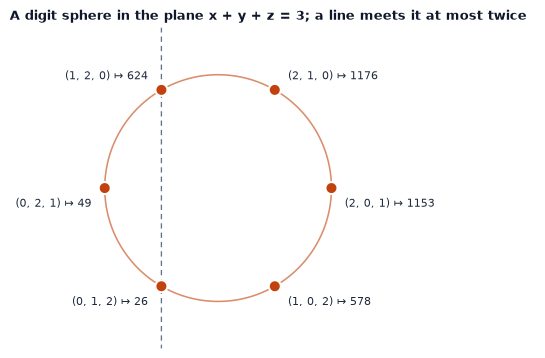
points    : [(0, 1, 2), (0, 2, 1), (1, 0, 2), (1, 2, 0), (2, 0, 1), (2, 1, 0)]
encodings : [26, 49, 578, 624, 1153, 1176]
checks    : 1,440  (= 120 ordered triples × 12 coefficient pairs)
All 1,440 relations fail. The 6 points are the permutations of \((0,1,2)\): they lie on the circle cut out of the sphere \(x^2+y^2+z^2=5\) by the plane \(x+y+z=3\).
Why no carries#
For digits \(0\le v_k<d\) and \(|i|,|j|\le L\), every digit of \(j(v_2-v_1)-i(v_3-v_1)\) has absolute value at most \(2L(d-1)<2Ld\), half the base. A base-\(4Ld\) expansion with digits in \((-2Ld,2Ld)\) vanishes only if every digit does, so a relation between encodings is a relation between the vectors, coordinate by coordinate:
base = 4 * L * d
coeffs = [c_ for c_ in range(-L, L + 1) if c_ != 0]
max_digit = 0
for v1, v2, v3 in permutations(pts, 3):
    for i in coeffs:
        for j in coeffs:
            if i != j:
                digits = [j * (b - a) - i * (c_ - a) for a, b, c_ in zip(v1, v2, v3)]
                max_digit = max(max_digit, max(abs(x) for x in digits))
print(f"largest digit |j(v2−v1) − i(v3−v1)| = {max_digit};  2L(d−1) = {2 * L * (d - 1)};  base/2 = {base // 2}")
assert max_digit <= 2 * L * (d - 1) < base // 2
largest digit |j(v2−v1) − i(v3−v1)| = 8; 2L(d−1) = 8; base/2 = 12
Why a line meets a sphere at most twice#
If \(j(v-u)=i(w-u)\) coordinatewise, the chord identity
holds; on a sphere the right side vanishes, so \(v=u\) when \(j\neq0\) and \(i\neq j\). The identity is checked here exactly on random integer data with \(v=u+i\Delta\), \(w=u+j\Delta\):
rng = random.Random(1946)
n_id = 10_000
for _ in range(n_id):
    n = rng.randint(1, 6)
    u = [rng.randint(-50, 50) for _ in range(n)]
    D = [rng.randint(-50, 50) for _ in range(n)]
    i, j = rng.randint(-9, 9), rng.randint(-9, 9)
    v = [a + i * b for a, b in zip(u, D)]
    w = [a + j * b for a, b in zip(u, D)]
    assert all(j * (b - a) == i * (c_ - a) for a, b, c_ in zip(u, v, w))
    nsq = lambda x: sum(t * t for t in x)
    lhs = j * (j - i) * nsq([b - a for a, b in zip(u, v)])
    rhs = i * i * (nsq(w) - nsq(u)) - i * j * (nsq(v) - nsq(u))
    assert lhs == rhs
print(f"chord identity verified exactly on {n_id:,} random instances")
chord identity verified exactly on 10,000 random instances
This identity and its consequence are proved for all dimensions in this repository’s Lean library
(BehrendReading.chord_identity, BehrendReading.sphere_rel; transitive axioms
propext, Classical.choice, Quot.sound), and in the archive as Formalism.FrobeniusOrbits.ThickExists.sphere_rel.
A larger exhaustive check#
The most populous sphere in \(\{0,\dots,d-1\}^S\) is what makes the construction large. For a few small \((S,d)\) we find it and run the same exhaustive relation check with \(L=2\); pigeonhole guarantees at least \(d^S/(S(d-1)^2+1)\) points on it.
from collections import Counter
rows = []
for S_, d_ in ((3, 3), (3, 5), (4, 4), (3, 7)):
    counts = Counter(sum(c_ * c_ for c_ in v) for v in product(range(d_), repeat=S_))
    best_norm, size = max(counts.items(), key=lambda kv: (kv[1], -kv[0]))
    pig = math.ceil(d_ ** S_ / (S_ * (d_ - 1) ** 2 + 1))
    _, enc_, checks_ = rhlib.behrend_example(S=S_, d=d_, L=2, norm=best_norm)
    assert len(enc_) == size >= pig
    rows.append((S_, d_, best_norm, size, pig, checks_))
    print(f"S = {S_}, d = {d_}: most populous squared norm {best_norm} with {size} points "
          f"(pigeonhole ≥ {pig});  {checks_:,} relation checks, none holds")
S = 3, d = 3: most populous squared norm 5 with 6 points (pigeonhole ≥ 3);  1,440 relation checks, none holds
S = 3, d = 5: most populous squared norm 17 with 9 points (pigeonhole ≥ 3);  6,048 relation checks, none holds
S = 4, d = 4: most populous squared norm 14 with 24 points (pigeonhole ≥ 7);  145,728 relation checks, none holds
S = 3, d = 7: most populous squared norm 41 with 15 points (pigeonhole ≥ 4);  32,760 relation checks, none holds
The largest of these runs checks 145,728 relations. The archive’s quantitative
version (hostThickExists, kernel-checked) produces a set of size at least
\(\frac nL e^{-C\sqrt{\log n\,\log L}}\) with an absolute constant \(C\), and HostThickOrbit turns the
relation avoidance into a bound of two points on short segments of high-order orbits.