The estimate: from a chain of theta lifts to a prime-sum bound#
The estimate A finite character comparison turns geometric control of a chain of theta lifts of length about √x into an upper bound for a weighted prime sum.
The analytic engine needs, for each primitive character \(\psi\) and each small \(\varepsilon\), a bound \(G_P(x)\le x^{1/2+(e_D+e_L+7)\varepsilon}\) for the level \(P\) of \(\psi\) on arbitrarily late windows. This stratum is where that bound is produced from geometry. Its centre, the finite character comparison, is machine-checked as an implication: it takes as hypotheses, at each scale \(x\), the existence of arithmetic data (a frame, a host, a set of classes) with explicit size, norm and discrepancy bounds, and returns the prime-sum bound. The data are the business of the theta chain and of the hosts.
8 · The finite character comparison#
The estimate ✓ Kernel-checked at the archive pin core_gm · ch_core · ch_top
The gist
Finite Fourier orthogonality on a subgroup and an exact main-term identity convert a geometric discrepancy bound into the prime-sum bound, with exponent \(\tfrac12+(e_D+e_L+7)\varepsilon\).
Statement (paraphrase of the archive’s Lean statements in standard notation):
The geometric discrepancy contains a cost proportional to \(x/m\) and another proportional to \(m\). With \(m=x^a\) the larger exponent is \(\max(1-a,a)\), smallest at \(a=\tfrac12\): this is the square root. The worst of the four budget terms is \(4x^{1/2+13\varepsilon/8}\).
Summing a character over the subgroup annihilates it unless it is trivial there; the survivors that are not retained (\(\Sigma\le 4o\,x^{1/2+\varepsilon}\)) need a separate square-root input (EAtH.bdG). The losses add up to exactly \((e_D+e_L+7)\varepsilon\).
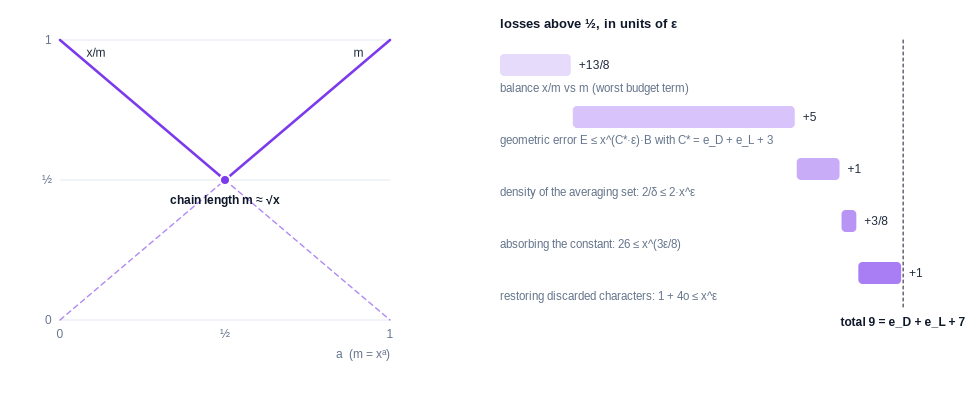
Fig. 9 Where the square root and each epsilon are paid. Left: exponents 1-a of x/m and a of m when m = x^a; the larger is smallest at a = 1/2. Right: exact staircase of the losses in units of epsilon, from the finite comparison to 1/2 + (e_D+e_L+7) eps = 1/2 + 9 eps for the source’s choice e_D = 2, e_L = 0.#
Lean declaration (archive, pinned at the mirror commit) |
Note |
|---|---|
from the height discrepancy to the prime sum |
|
average over characters |
|
bound the discrepancy per index |
|
the estimate on a whole window |
Verification. ✓ Kernel-checked at the archive pin Named declarations passed type, transitive-axiom (only propext, Classical.choice, Quot.sound) and kernel-replay checks at Lean 4.33.1.
Status in the imported record (20 November 2026, 23:51 UTC). ch_top, ch_core, core_gm and windowInequality_of_artinInputs passed at the archive pin (316 modules), with the comparison hypotheses EAtH and CoreAtH explicit.
What remains to check. The hypotheses: existence of the hosts, frames and witnesses at every scale of the window, and the square-root bound for discarded characters.
Blueprint. 5 of the reading project’s declarations belong to this component (4 kernel-checked at the archive pin, 1 inside a checked closure); see 8 · The finite character comparison.
Receives from 9 · The geometric family and the theta chain: TopG (e_D = 2, e_L = 0) (UpperTheory.Top.TopG); from 10 · Hosts for every character: hosts, width 3/2 (UpperTheory.Top.supplyChi).
Delivers to 7 · The order of choices: G_P ≤ x^(½+9ε) on windows (level_gm_le_on_family_scales).
Verified cuts through this component: TopG and the cohomological windows imply RH and Dirichlet GRH.
Announcement entries: 14 (15 Nov: The provisional exponent two-thirds); 16 (14 Oct: Period pairings and approximate orthogonality) — see The announcement’s twenty entries.
What is fixed and what is estimated#
The comparison theorem UpperTheory.Comparison₂.core_gm fixes the level \(\Lambda\), real parameters
\(e_D,e_L,K,c_{HH},e_K,C\) and \(\varepsilon>0\), and then produces a threshold \(x_1\). At each scale
\(x\ge x_1\) it receives a finite frame (a finite abelian group \(A\) with a translation subgroup \(A_0\)),
an arithmetic host, a set \(T\) of classes, and two packages of hypotheses at that same \(x\):
EAtH (the characters, their smoothed sums and the shares of \(T\)) and CoreAtH (the witnesses,
weights, slopes and size bounds). The frame and the witnesses may change with \(x\); the threshold
may not. A single application gives an estimate at one scale — arbitrarily late windows require
the family construction of the next section.
Which characters survive the subgroup average#
The Fourier group is \(E_0\times A\) with \(E_0=(\mathbb Z/2)^2\). Writing \(e_1(t)=((1,0),t)\) and \(\Psi_0\) for the characters trivial on \(\{0\}\times A_0\), translation gives, for \(s\) in the subgroup set \(T_2\),
Averaging the per-translation discrepancy bounds over \(A_0\) therefore leaves exactly the characters
in \(\Psi_0\). Those that are retained in the level carry the weights of \(G_\Lambda\); the others — the
discarded survivors — contribute a term \(\Sigma(x)\), which a separate square-root input (EAtH.bdG)
bounds by \(4o\,x^{1/2+\varepsilon}\). With \(Q=umb\), \(\delta=v/n\) and \(E\) the common bound on the geometric
discrepancy, the finite comparison reads
The budget: where \(\sqrt x\) and each \(\varepsilon\) are paid#
The geometric proof gives \(E\le x^{C_*\varepsilon}B\) with \(C_*=e_D+e_L+3\), where \(B\) is an exact bracket with four terms. Under the simultaneous size hypotheses of the source, the four terms of \(B/Q\) are bounded as follows (exponents in exact arithmetic; recomputed in The square-root balance and the exact staircase of losses):
Term of \(B/Q\) |
Coefficient |
Exponent of \(x\) |
From the size hypotheses |
|---|---|---|---|
\(a_E/(mb)\) |
2 |
\(\tfrac12+\varepsilon\) |
\(a_E/(mb)\le 2x/m\) and \(m\ge x^{1/2-\varepsilon}\) |
\(a_E m/(bk)\) |
2 |
\(O(1)\) |
\(xm\le k\) |
\(2\,(n/u)\,m\,x^{\varepsilon}\) |
4 |
\(\tfrac12+\tfrac{13}{8}\varepsilon\) |
\(n/u\le 2x^{\varepsilon/8}\), \(m\le x^{1/2+\varepsilon/2}\), and the explicit \(x^{\varepsilon}\) |
\((v/u)(k/n^2)\,x^{2\varepsilon}\) |
2 |
\(\tfrac12+\tfrac{9}{8}\varepsilon\) |
\(v/u\le n/u\le 2x^{\varepsilon/8}\), \(k/n^2\le x^{1/2-\varepsilon}\), and the explicit \(x^{2\varepsilon}\) |
The first and third rows are the heart of the matter. Ignoring the \(x^{O(\varepsilon)}\) factors and writing the chain length as \(m=x^a\), one pays \(x/m=x^{1-a}\) and \(m=x^a\); the larger exponent \(\max(1-a,a)\) is smallest at \(a=\tfrac12\). This is where the square root of the Riemann hypothesis comes from in this argument: a chain of about \(\sqrt x\) theta lifts balances the two costs. The worst term carries \(x^{1/2+13\varepsilon/8}\), and the remaining steps add the losses recorded in the staircase:
Step |
Loss (units of \(\varepsilon\)) |
Running total |
|---|---|---|
balance x/m vs m (worst budget term) |
\(+\tfrac{13}{8}\) |
\(\tfrac{13}{8}\) |
geometric error E ≤ x^(C*·ε)·B with C* = e_D + e_L + 3 |
\(+5\) |
\(\tfrac{53}{8}\) |
density of the averaging set: 2/δ ≤ 2·x^ε |
\(+1\) |
\(\tfrac{61}{8}\) |
absorbing the constant: 26 ≤ x^(3ε/8) |
\(+\tfrac{3}{8}\) |
\(8\) |
restoring discarded characters: 1 + 4o ≤ x^ε |
\(+1\) |
\(9\) |
The total is \(e_D+e_L+7\), independent of the particular constants, and equals \(9\) for the source’s choice \(e_D=2\), \(e_L=0\). The proof that the scalar inequalities really allow the worst term — an explicit admissible choice of all parameters attaining \(4x^{1/2+13\varepsilon/8}\) — is in The square-root balance and the exact staircase of losses.
What the comparison does not supply#
The comparison consumes three things it does not prove: the existence of the geometric data at every scale of a window, the discrepancy bound \(E\) (the geometric content), and the square-root bound for the discarded characters. The last is a square-root bound for finitely many specific characters; the auxiliary-prime theorem of 12 · Auxiliary primes and Behrend towers proves bounds of this shape for quadratic twists, and how the chosen primes feed a fixed target character is one of the points the model lists as still to check. The machine-checked statement is the implication with these hypotheses explicit.
9 · The geometric family and the theta chain#
The estimate ◐ Partly checked topDesWin · RankVal
The gist
A chain of about \(\sqrt x\) theta lifts, with divisibility, slope and covolume control, is chosen so that both loss exponents are fixed numbers: \(e_D=2\), \(e_L=0\).
Statement (paraphrase of the archive’s Lean statements in standard notation):
TopShape calls topDesWin with \(C_{\rm abs}=2\), \(C_0=3\), \(e_D=2\), \(e_L=0\), which gives the exponent \(\tfrac12+9\varepsilon\). RankVal fixes the chain length; the announcement’s “length of chain of theta lifts \(\sqrt X\)” is this parameter.
Three local tools are visible in isolation: the denominators of an iterated kernel clear by \(\prod_j D_j\) (ChainInt); a \(2\times2\) minor is divisible by \(w\) when \(w^2=p\) (key_minor_dvd); and Bost’s slope inequality bounds the slope of an injectively mapped lattice. The global gain requires these to hold simultaneously on one family.
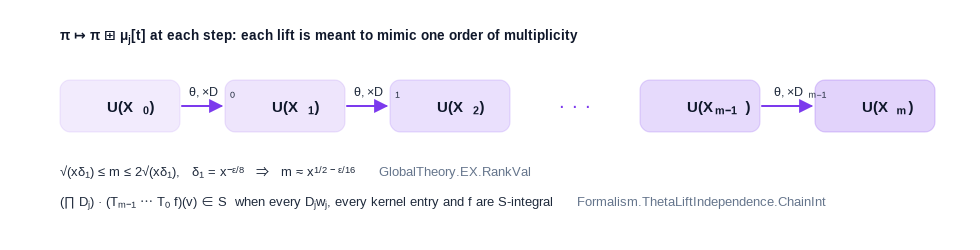
Fig. 10 The chain of theta lifts (schematic). Schematic: unitary groups U(X0) -> U(X1) -> … -> U(Xm) linked by theta lifts; each lift carries a denominator D_j; the archive’s RankVal puts m between sqrt(x delta1) and 2 sqrt(x delta1), delta1 = x^(-eps/8).#
Lean declaration (archive, pinned at the mirror commit) |
Note |
|---|---|
combine divisibility, slopes and windows |
|
calls topDesWin with e_D = 2, e_L = 0 |
|
the chain length and the other ranks |
|
a local source of divisibility |
|
the lattice slope inequality |
Verification. ◐ Partly checked Some of the component’s named declarations are kernel-checked; the producers of its remaining inputs are source-read.
Status in the imported record (20 November 2026, 23:51 UTC). key_minor_dvd passed in its 509-module closure. topDesWin and the family construction are source-read here and included in the externally reported full build.
What remains to check. Nonempty compatible data: follow the witnesses of one geometric family through the test-vector grids, linked bundles and definite-side hypotheses.
Blueprint. 11 of the reading project’s declarations belong to this component (1 kernel-checked at the archive pin, 9 source-read, 1 motivation); see 9 · The geometric family and the theta chain.
Receives from 14 · Seven inputs at the decisive call: definite-side data (every_character_of_theta_integrals_local_matching).
Delivers to 8 · The finite character comparison: TopG (e_D = 2, e_L = 0) (UpperTheory.Top.TopG).
Verified cuts: this component lies outside both machine-checked implications (see The two verified cuts).
Announcement entries: 1 (6 Oct: Stepanov determinant); 2 (9 Oct: Invariant differentials on a CM curve); 8 (15 Nov: A chain with square-root length); 9 (15 Nov: Norms, levels and arithmetic periods); 10 (15 Nov: Divisibility of repeated lifts); 13 (6 Oct: The slope inequality); 15 (15 Nov: A common integral structure across characters) — see The announcement’s twenty entries.
The parameters of a chain#
At a scale \(x\) with small \(\varepsilon\) the source sets \(\delta_1=x^{-\varepsilon/8}\), and the predicate
GlobalTheory.EX.RankVal fixes integers \(n,m,k\) with
So the chain length is \(m\asymp x^{1/2-\varepsilon/16}\), comfortably inside the window \(x^{1/2-\varepsilon}\le m\le x^{1/2+\varepsilon/2}\) demanded by the comparison: this is the precise meaning of the announcement’s “chain of theta lifts of length \(\sqrt X\)” (entry 8). The same predicate ties an auxiliary rank \(t\) to these parameters; its growth is what the fixed cutoff exponent \(401\) of the cohomological window has to dominate. All of this is a hypothesis of the downstream implications; producing families with these ranks is a separate task.
Three local mechanisms, visible in isolation#
Denominators clear along the chain (
ThetaLiftIndependence.ChainInt). For finite kernels \((Tf)(v)=\sum_u w(u)f(u)K(u,v)\) with \(D_jw_j\) and all kernel entries in a subring \(S\), one has \(\big(\prod_{j<m}D_j\big)(T_{m-1}\cdots T_0f)(v)\in S\). This is bookkeeping; a gain needs actual automorphic maps with controlled denominators and norms.A divisor appears in a minor (
key_minor_dvd, kernel-checked). If \(w^2=p\) in a commutative ring \(A\), two rows supported at index \(0\) modulo \(w\), and \(M^{p^e}\equiv N'\) entrywise modulo \(p\), then modulo \(w\) both transformed rows are multiples of the same row, so \(w\) divides the \(2\times2\) minor \(W_cV_0-W_0V_c\) — even when \(A/(w)\) has zero divisors.Slopes of lattices (
slopeInequality_of). For an injective integral map \(\phi:A\to B\) of Euclidean lattices with \(\|\phi v\|\le C\|v\|\), comparing Gram determinants gives \(\mu(A)\le\mu_{\max}(B)+\log C\), where \(\mu=-\log(\mathrm{covol})/\mathrm{rank}\) (Bost’s slope inequality; the general sublattice bound \(\mu(A')\le\mu_{\max}(B)\) is a named hypothesis).
Fixing the losses#
TopShape calls the family constructor UpperTheory.Top.topDesWin with the constants on the
card, which fixes \(e_D=2\) and \(e_L=0\) before \(\varepsilon\) is chosen; this is the uniformity that
7 · The order of choices needs. The constructor combines existence of a design, family inclusions,
the window hypothesis HypV, the links LinkN, LinkEta, LinkIRR, a rank equality, and the
divisibility, rank and global links — on one family. The local facts above are each plausible
and some are checked; that they hold simultaneously on a single family at every scale of a window
is the substantive claim. The source also contains identities that are uniform over an index set
(for instance a volume identity for every admissible character datum); whether such an index set
is nonempty is a separate question, which is why “nonempty compatible data” is one of the open
audit items in The verification ledger.
10 · Hosts for every character#
The estimate ✓ Kernel-checked at the archive pin supplyChi
The gist
For each primitive character \(\psi\), the cohomological window produces arithmetic hosts of width \(3/2\) at all large scales of a system of scales.
Statement (paraphrase of the archive’s Lean statements in standard notation):
The supplier is applied separately to each character; a common host for all characters would be a stronger quantifier order and is not needed. The character requirement combines the cyclotomic-level condition EAtH with the cohomological inequality for the host field.
Lean declaration (archive, pinned at the mirror commit) |
Note |
|---|---|
VWinAt ψ 401 ⇒ hosts of width 3/2 |
Verification. ✓ Kernel-checked at the archive pin Named declarations passed type, transitive-axiom (only propext, Classical.choice, Quot.sound) and kernel-replay checks at Lean 4.33.1.
Status in the imported record (20 November 2026, 23:51 UTC). supplyChi passed in the Dirichlet closure, with VWinAt ψ 401 as its hypothesis.
What remains to check. Its premise VWinAt ψ 401, for every primitive ψ.
Blueprint. 1 of the reading project’s declarations belong to this component (1 kernel-checked at the archive pin); see 10 · Hosts for every character.
Receives from 11 · The cohomological window: VWinAt ψ 401 (UpperTheory.Top.VWinAt).
Delivers to 8 · The finite character comparison: hosts, width 3/2 (UpperTheory.Top.supplyChi).
Verified cuts through this component: TopG and the cohomological windows imply RH and Dirichlet GRH.
What one character must supply#
Fix a primitive \(\psi\). The proposition VWinAt ψ 401 reads, in the archive’s quantifier order:
for every \(0<\varepsilon<\tfrac1{52}\) and every admissible layer function \(e:\mathbb R\to\mathbb N\), there
are \(J\ge1\) and \(X_0\) such that for every \(X\ge X_0\) and every pair of auxiliary primes \(q,d\)
admissible at scale \(X^{1/J}\), some \(Y\) with \(X^{1/J}\le Y\) and \(Y^2\le X\) makes the cohomological
bound of 11 · The cohomological window hold at every \(x\in[Y,Y^2]\). The interval may depend on \(X,q,d\); the
exponent \(J\) may not; all choices may depend on \(\psi\).
The supplier supplyChi ψ (kernel-checked, with VWinAt ψ 401 as hypothesis) turns this into
hosts of width \(3/2\) satisfying the character requirement (GChi ψ).req, which combines the
cyclotomic-level condition EAtH with the cohomological inequality for the host field. Hosts are
produced per character: a common host for all characters would be a stronger quantifier order
and is not needed. zeroFreeAll_of_topG then takes the width \(\lambda=3/2\), the requirement
GChi ψ, the hosts and TopG, and returns the primitive half-plane statement ZeroFreeAll.