The analytic engine: from one-sided windows to a zero-free half-plane#
The analytic engine A localized Landau oscillation argument converts one-sided bounds on whole power windows into a zero-free half-plane.
This stratum is the part of the argument that can be stated, and has been checked, entirely within classical analytic number theory. Its input is a one-sided estimate for a weighted prime sum on sparse but long intervals; its output is a zero-free half-plane. The mechanism is Landau’s oscillation theorem, made local: positivity forces the transform of the prime sum to have a pole with an uncancellable residue at any zero, and high derivatives of the transform, which sample the prime sum essentially on one window, cannot be small near such a pole.
4 · The centered prime sum#
The analytic engine ✓ Kernel-checked at the archive pin what must be bounded
The gist
A ramp-weighted von Mangoldt sum, centered so that the main terms cancel exactly, and its positive combinations over a cyclic family of characters.
Statement (paraphrase of the archive’s Lean statements in standard notation):
Here \(g_\chi(y)=\sum_{n\le y}\Lambda(n)\chi(n)(y/n-1)+y\,(L'/L)(1,\chi)\) for nonprincipal primitive \(\chi\), and \(P\) consists of the primitive characters inducing the cyclic group generated by a fixed primitive \(\psi\) (order \(o\)). At the trivial level \(G_P=G\).
By the explicit formula \(G(y)=\log 2\pi-\sum_\rho y^\rho/(\rho(\rho-1))+O(y^{-2})\), so under RH \(|G(y)-\log 2\pi|\le(2+\gamma-\log 4\pi)\sqrt y\). The proof needs much less: an upper bound \(G_P(x)\le x^{1/2+O(\varepsilon)}\) on whole windows.
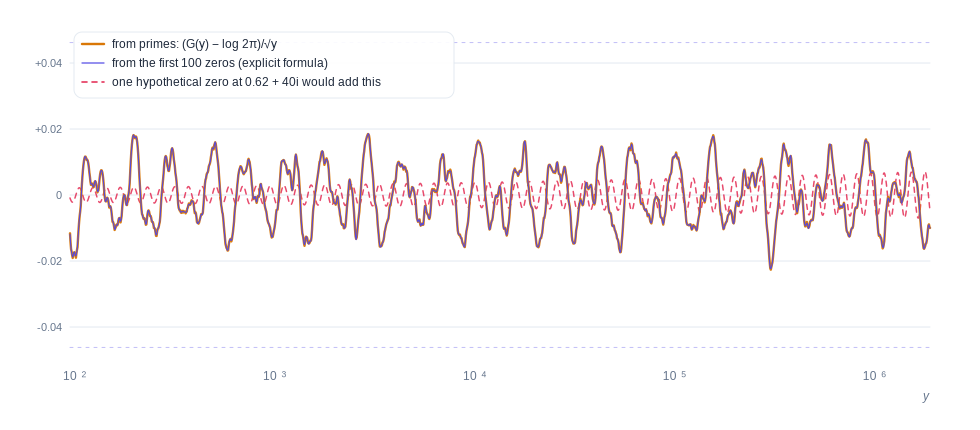
Fig. 4 Prime sum versus the sum over zeros. Computed: normalized G(y) from primes (amber) and the explicit formula with the first 100 zeta zeros (indigo), 100 <= y <= 2e6; dashed: the term a hypothetical zero at 0.62+40i would add (it grows like y^0.12).#
Lean declarations (archive, pinned at the mirror commit) |
|---|
Verification. ✓ Kernel-checked at the archive pin Named declarations passed type, transitive-axiom (only propext, Classical.choice, Quot.sound) and kernel-replay checks at Lean 4.33.1.
Status in the imported record (20 November 2026, 23:51 UTC). Gz_eq (Formalism.Gz = An.G = Deduction.G pointwise) passed its checks in a 130-module union; the definitions are inside every checked closure below.
What remains to check. None: a definition and a checked normalization identity.
Blueprint. 8 of the reading project’s declarations belong to this component (1 kernel-checked at the archive pin, 7 inside a checked closure); see 4 · The centered prime sum.
Delivers to 5 · Mellin transform and positive residues: Mellin transform (MellinRamp).
Verified cuts through this component: One-sided prime windows imply RH and TopG and the cohomological windows imply RH and Dirichlet GRH.
Announcement entries: 5 (20 Oct: The smoothed von Mangoldt sum) — see The announcement’s twenty entries.
Why exactly these centering terms#
Write \(\psi(t)=\sum_{n\le t}\Lambda(n)\) and \(E(t)=\psi(t)-t\). Each jump \(\Lambda(n)\) of \(\psi\) at \(n\le x\) contributes \(x\int_n^x t^{-2}\,dt=x/n-1\) to \(x\int_1^x\psi(t)t^{-2}\,dt\), so
Integrating the Dirichlet series of \(-\zeta'/\zeta\) by parts gives, for real \(s>1\), \(-\zeta'(s)/\zeta(s)=s/(s-1)+s\int_1^\infty E(t)t^{-s-1}\,dt\); comparing with the Laurent expansion \(-\zeta'/\zeta(s)=1/(s-1)-\gamma+O(s-1)\) and letting \(s\downarrow1\) yields \(\int_1^\infty E(t)t^{-2}\,dt=-1-\gamma\). Hence
so the linear term \((1+\gamma)x\) is exactly the one that cancels the main terms, and the size of \(G\) is governed by the tail of the prime number theorem’s error. The same identity shows why \(G\) is the natural ramp-smoothed object: it is a weighted average of \(E\) over \([x,\infty)\).
The explicit formula#
Shifting the contour in the Perron-type integral for the ramp sum picks up the residues of \(-\frac{\zeta'}{\zeta}(s)\,\frac{y^s}{s(s-1)}\): at \(s=1\) the double pole produces \(y\log y-(1+\gamma)y\), which \(G\) subtracts; at \(s=0\) the residue is \(\log 2\pi\); each nontrivial zero \(\rho\) contributes \(-y^\rho/(\rho(\rho-1))\) and each trivial zero \(-2n\) a term of size \(y^{-2n}\):
If every \(\rho\) has real part \(\tfrac12\), then \(\rho(\rho-1)=-|\rho|^2\) and \(\sum_\rho|\rho|^{-2}=\sum_\rho\frac1{\rho(1-\rho)}=2+\gamma-\log4\pi\), so that \(|G(y)-\log2\pi|\le(2+\gamma-\log4\pi)\sqrt y+O(y^{-2})\); the constant is 0.0462. The computed normalized sum \((G(y)-\log2\pi)/\sqrt y\) stays between -0.0227 and 0.0187 for all sampled \(y\) from 10 to 10⁷, and the sum over the first hundred zeros reproduces it; both computations are redone in The centered prime sum and the explicit formula. A single zero \(\rho=\beta+i\gamma\) with \(\beta>\tfrac12\) would add an oscillation of amplitude \(\asymp y^{\beta}\) in both directions. The whole engine rests on the observation that, thanks to positivity, it is enough to forbid the upward swings.
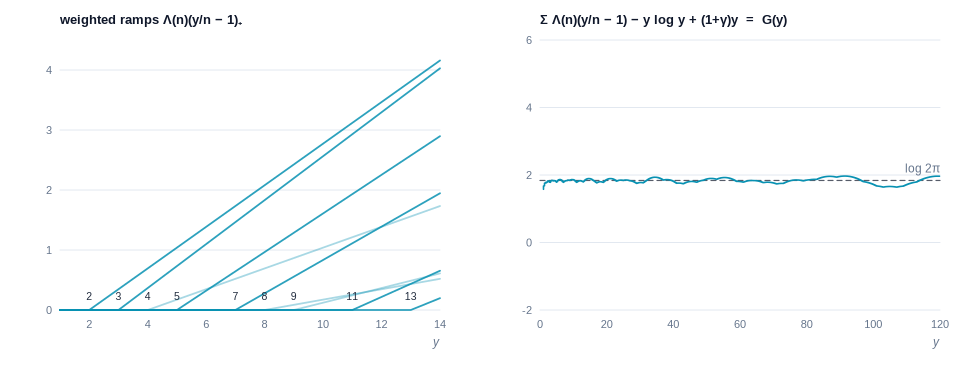
Fig. 5 Ramps and the centered sum. Computed. Left: the weighted ramps Lambda(n)(y/n-1)_+ for prime powers n <= 13, each switching on at y = n with slope Lambda(n)/n. Right: their full sum minus y log y - (1+gamma) y, i.e. G(y), for 1 <= y <= 120; it hovers around log 2pi (dashed), the residue at s = 0.#
Families of characters#
For a nonprincipal primitive \(\chi\) the source uses \(g_\chi(y)=\sum_{n\le y}\Lambda(n)\chi(n)(y/n-1)+y\,(L'/L)(1,\chi)\); the linear term again removes the contribution of \(s=1\) to the transform. Fix a primitive \(\psi\) of order \(o\) and let \(P\) be the set of primitive characters inducing the elements of the cyclic group \(\langle\psi\rangle\). The level \(G_P(x)=G(x)+\frac1{3o+1}\sum_{\chi\in P\setminus\{1\}}\Re g_\chi(x)\) is a positive combination; the weight \(\frac1{3o+1}\) is small enough that the comparison of the next stratum can control it. A principal member of a family must have modulus one, because removing Euler factors would change the linear main term.
5 · Mellin transform and positive residues#
The analytic engine ✓ Kernel-checked at the archive pin poleData
The gist
The Mellin transform of a ramp is \(n^{-s}/(s(s-1))\); a zero of any family member becomes a pole whose residue cannot be cancelled, because the weights are positive.
Statement (paraphrase of the archive’s Lean statements in standard notation):
Summing ramps against \(\Lambda(n)\chi(n)\) produces \(-L'/L\); the compensating linear term removes the pole at \(s=1\), so \(\int_1^\infty G_\chi(y)y^{-s-1}dy=-[(L'/L)(s,\chi)-s(L'/L)(1,\chi)]/(s(s-1))\).
Taking real parts averages \(\chi\) and \(\chi^{-1}\), so every member vanishing at \(\rho\) contributes a positive multiple of the same complex number. For a real zero \(0<\beta<1\) the residue is even positive, which lets the one-sided bound exclude exceptional real zeros too.
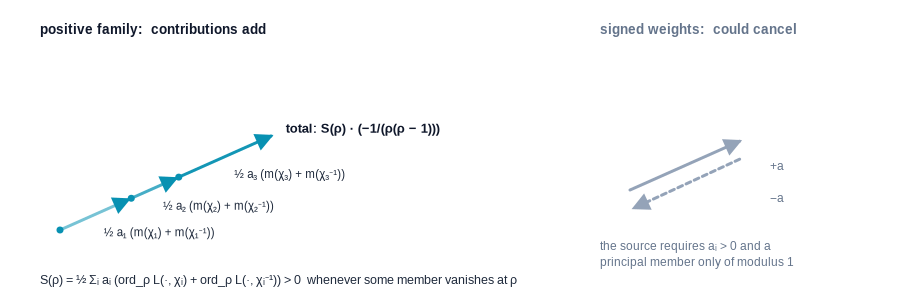
Fig. 6 Positive weights keep the residue alive. Schematic, exact in direction: at a common zero rho every member of a positive family contributes a positive multiple of the same complex number -1/(rho(rho-1)), so the contributions add; with signed weights two contributions could cancel.#
Lean declarations (archive, pinned at the mirror commit) |
|---|
Verification. ✓ Kernel-checked at the archive pin Named declarations passed type, transitive-axiom (only propext, Classical.choice, Quot.sound) and kernel-replay checks at Lean 4.33.1.
Status in the imported record (20 November 2026, 23:51 UTC). Deduction.poleData passed type, axiom and kernel checks (38-module landmark closure, Helios job 26639692).
What remains to check. None: an analytic lemma, machine-checked.
Blueprint. 1 of the reading project’s declarations belong to this component (1 kernel-checked at the archive pin); see 5 · Mellin transform and positive residues.
Receives from 4 · The centered prime sum: Mellin transform (MellinRamp).
Delivers to 6 · The window criterion: pole data, S(ρ) > 0 (Deduction.poleData).
Verified cuts through this component: One-sided prime windows imply RH and TopG and the cohomological windows imply RH and Dirichlet GRH.
The computation#
For \(n\ge1\) and \(\Re s>1\), the ramp vanishes below \(n\), and
Summing against \(\Lambda(n)\chi(n)\) gives \(-\frac{L'}{L}(s,\chi)/(s(s-1))\), and the linear term of \(g_\chi\) integrates to \(\frac{L'}{L}(1,\chi)/(s-1)\), so
whose numerator vanishes at \(s=1\): the transform continues analytically to wherever \(L'/L\) does, and its only singularities in \(0<\Re s<1\) are at zeros of \(L(s,\chi)\).
Why the weights must be positive#
On real arguments \(\Re g_\chi=\tfrac12(g_\chi+g_{\bar\chi})\), so the transform of \(G_F=\sum_i a_i\Re g_{\chi_i}\) has at \(s=\rho\) the residue
where \(m_\chi(\rho)\ge0\) is the order of vanishing. With \(a_i>0\), \(S(\rho)>0\) as soon as one member
(or its conjugate) vanishes at \(\rho\): the contributions of different characters point in the same
complex direction and cannot cancel. For a real zero \(0<\beta<1\) the residue is even positive,
because \(\beta(\beta-1)<0\), and the same one-sided bound excludes exceptional (Siegel) zeros of
the family. In Lean this is Deduction.poleData; the archive also proves the positivity of
\(S(\rho)\) separately (both are linked on the card).
6 · The window criterion#
The analytic engine ✓✓ Checked by two kernels localized Landau
The gist
If a positive family’s prime sum stays below \(Cy^\theta\) throughout arbitrarily late windows \([Y,Y^{1+\delta}]\), none of its \(L\)-functions vanishes to the right of \(\theta\).
Statement (paraphrase of the archive’s Lean statements in standard notation):
With \(u=\log y\) and \(g(u)=G_F(e^u)\), the moments \(A_k(z)=\int g(u)\,\frac{u^k e^{-\sigma u}}{k!}e^{-itu}\,du\) are \((-1)^k\Phi^{(k)}(z)/k!\) for the Laplace transform \(\Phi\). The kernel peaks at \(u=k/\sigma\), so \(k=\lceil(1+\delta/2)\sigma U\rceil\) aims it at the window \([U,(1+\delta)U]\); the tails are exponentially small.
The one-sided trick: \(|g|+g=2\max(g,0)\le 2R\) for any majorant \(R\ge g\), which controls \(|A_k(\sigma+it)|+\operatorname{Re}A_k(\sigma)\). A pole at distance \(d\) contributes about \(d^{-k}\) while the window bound gives \(e^{\eta U}r^{-k}\) with \(r>d\); since \(k\ge U\) and \(\eta\) is arbitrary, the pole cannot exist.
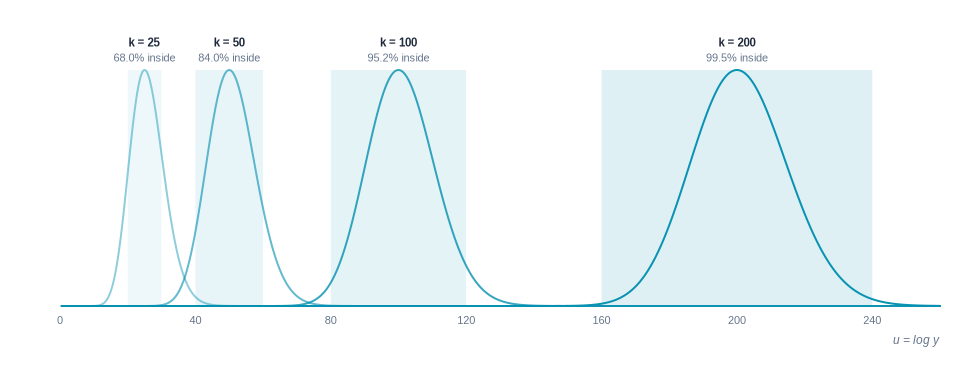
Fig. 7 The spotlight of high derivatives. Computed: kernels u^k e^{-u}/k! (normalized to peak 1) with k = ceil(1.25 U) for U = 20, 40, 80, 160 and the windows [U, 1.5 U] in u = log y; labels give the fraction of each kernel’s mass inside its window.#
Lean declaration (archive, pinned at the mirror commit) |
Note |
|---|---|
the criterion (statement) |
|
rule out a pole right of θ |
|
Verification. ✓✓ Checked by two kernels Accepted by two independent proof checkers in runs of the reading project: a Lean replay or verified-mode comparison, and the Rust kernel NanoDA. The ledger names the runs and their receipts.
Status in the imported record (20 November 2026, 23:51 UTC). zeroFree_of_rpow_window passed at the archive pin; its specialization to zeta (riemannHypothesis_of_prime_windows) passed a fresh Lean replay over 10,530 modules and the Rust kernel NanoDA on 61,697 exported declarations.
What remains to check. None: machine-checked twice.
Blueprint. 4 of the reading project’s declarations belong to this component (1 kernel-checked at the archive pin, 3 inside a checked closure); see 6 · The window criterion.
Receives from 5 · Mellin transform and positive residues: pole data, S(ρ) > 0 (Deduction.poleData).
Delivers to 7 · The order of choices: criterion at each level (zeroFree_of_rpow_window).
Verified cuts through this component: One-sided prime windows imply RH and TopG and the cohomological windows imply RH and Dirichlet GRH.
Announcement entries: 6 (8 Oct: Two-support positivity test) — see The announcement’s twenty entries.
High derivatives as a spotlight#
Put \(u=\log y\), \(g(u)=G_F(e^u)\) and let \(\Phi(z)=\int_0^\infty g(u)e^{-zu}\,du\) be the Laplace transform (the Mellin transform above). For \(z=\sigma+it\),
The kernel \(u^ke^{-\sigma u}/k!\) is a Gamma density up to the factor \(\sigma^{-(k+1)}\): it peaks at \(u=k/\sigma\) and has width \(\asymp\sqrt k/\sigma\). With \(k=\lceil(1+\delta/2)\sigma U\rceil\) it is aimed at the middle of the logarithmic window \([U,(1+\delta)U]\), i.e. of \([Y,Y^{1+\delta}]\) with \(U=\log Y\), and the fraction of its mass inside the window tends to \(1\) exponentially fast. For \(\sigma=1\), \(\delta=\tfrac12\) and \(U=\)20, 40, 80, 160 the computed fractions are 68.0%, 84.0%, 95.2%, 99.5% (The spotlight kernel and the window masses). The tails outside the window are controlled by a crude global bound \(|g(u)|\le C_0e^{2u}\) and a choice \(\sigma>2\).
The one-sided trick#
Inside the window only an upper bound \(g\le R\) is available. The elementary identity
integrated against the kernel bounds \(|A_k(\sigma+it)|+\Re A_k(\sigma)\) — the shifted moment together with the signed, unshifted one. Along the derivative orders aimed at the windows this gives \(|A_k(\sigma+it)|+\Re A_k(\sigma)\ll e^{\eta U}(\sigma-\theta)^{-k}\) for every \(\eta>0\) when \(g(u)\le Ce^{\theta u}\) on the windows.
Why a pole cannot hide#
A simple pole \(c/(z-\rho)\) of \(\Phi\) contributes \(c/(z-\rho)^{k+1}\) to \(A_k(z)\). If \(\Re\rho>\theta\), the source separates two cases. Either a vertical shift isolates a unique nearest pole with a pole-free disc around the unshifted point, and Cauchy estimates make the analytic remainder geometrically smaller than the pole’s contribution; or a real pole dominates, and its positive residue makes \(\Re A_k(\sigma)\) large. In both cases the pole contributes \(\asymp d^{-k}\) while the window bound gives \(e^{\eta U}r^{-k}\) with \(d<r\le\sigma-\theta\). Since \(k\ge U\), \((r/d)^k\ge e^{U\log(r/d)}\), which beats \(e^{\eta U}\) once \(\eta<\log(r/d)\). So no member of the family vanishes in \(\Re s>\theta\). Because only the existence of arbitrarily late windows is used, the windows may be extremely sparse.
How strong is the window condition?#
For the singleton family \(\{\zeta\}\) the window condition is not only sufficient for RH but also necessary. Under RH, Schoenfeld’s Theorem 10 (Math. Comp. 1976) gives \(|\psi(t)-t|<\sqrt t\log^2t/(8\pi)\) for \(t\ge73.2\), and the identity \(G(x)=-x\int_x^\infty E(t)t^{-2}dt\) of 4 · The centered prime sum integrates this to
which is \(\le C_\theta x^\theta\) for every \(\theta>\tfrac12\) and every large \(x\) — on every window, not just on sparse ones. The first verified cut is therefore an equivalence in disguise: it isolates the analytic engine as correct and moves all of the difficulty of RH into its premise. (The computed values of \(G\) satisfy this bound with a large margin on the range of The centered prime sum and the explicit formula; that is consistent with, not evidence for, the hypothesis.)
7 · The order of choices#
The analytic engine ✓ Kernel-checked at the archive pin θ after the zero, ε after θ
The gist
The loss exponents are fixed first; given a zero with \(\beta>\tfrac12\) choose \(\theta\in(\tfrac12,\beta)\), then \(\varepsilon\) with \(\tfrac12+9\varepsilon\le\theta\). No bound at \(\varepsilon=0\) is ever needed.
Statement (paraphrase of the archive’s Lean statements in standard notation):
This is where the arithmetic and the analysis meet. The arithmetic must deliver, for every small \(\varepsilon\), families with \(G_P(x)\le x^{1/2+(e_D+e_L+7)\varepsilon}\) on arbitrarily late windows \([Y,Y^{3/2}]\), with \(e_D,e_L\) independent of \(\varepsilon\). The families themselves may depend on \(\varepsilon\).
Applying the criterion at each primitive character’s cyclic level gives ZeroFreeAll: \(L(s,\psi)\neq0\) for \(\operatorname{Re}s>\tfrac12\) and every primitive \(\psi\).
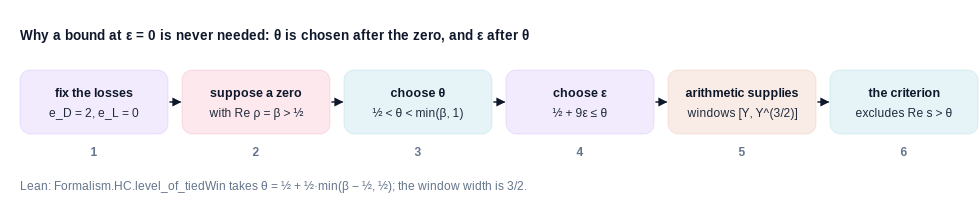
Fig. 8 The order of choices (schematic). Schematic: the loss exponents are fixed first; a candidate zero beta > 1/2 is given; theta is chosen between 1/2 and beta; epsilon is chosen so that 1/2 + (e_D+e_L+7) eps <= theta; the arithmetic then supplies windows for that epsilon; the analytic criterion excludes the zero.#
Lean declaration (archive, pinned at the mirror commit) |
Note |
|---|---|
choice of θ and ε after a candidate zero |
|
TopG and hosts ⇒ primitive zero-free half-plane |
|
selects the window width 3/2 |
Verification. ✓ Kernel-checked at the archive pin Named declarations passed type, transitive-axiom (only propext, Classical.choice, Quot.sound) and kernel-replay checks at Lean 4.33.1.
Status in the imported record (20 November 2026, 23:51 UTC). zeroFreeAll_of_topG passed its checks in the 1,421-module Dirichlet closure.
What remains to check. None for the logic; the premise TopG is the arithmetic input.
Blueprint. 5 of the reading project’s declarations belong to this component (1 kernel-checked at the archive pin, 3 inside a checked closure, 1 source-read); see 7 · The order of choices.
Receives from 8 · The finite character comparison: G_P ≤ x^(½+9ε) on windows (level_gm_le_on_family_scales); from 6 · The window criterion: criterion at each level (zeroFree_of_rpow_window).
Delivers to 3 · Conductor descent: ZeroFreeAll (primitive) (zeroFreeAll_of_topG).
Verified cuts through this component: TopG and the cohomological windows imply RH and Dirichlet GRH.
Quantifiers, in the order the proof uses them#
The arithmetic has to deliver, for each primitive \(\psi\), a statement of the shape
The loss exponents \(e_D,e_L\) come first and do not depend on \(\varepsilon\); the family, the constants and the windows may. Given a hypothetical zero with real part \(\beta>\tfrac12\), the proof takes \(\theta=\tfrac12+\tfrac12\min(\beta-\tfrac12,\tfrac12)\), so that \(\tfrac12<\theta<\min(\beta,1)\), then any \(\varepsilon\) with \(\tfrac12+(e_D+e_L+7)\varepsilon\le\theta\), and applies the window criterion at exponent \(\theta\). With the source’s \(e_D=2\), \(e_L=0\): for \(\beta=0.52\) one gets \(\theta=\)0.51 and may take any \(\varepsilon\le\)1/900.
This order is why the argument never needs a bound with \(\varepsilon=0\): a bound \(G_P(x)\le x^{1/2+o(1)}\) along windows, with the \(o(1)\) controlled uniformly in the sense above, is enough. It is also why the uniformity of \(e_D,e_L\) is a genuine requirement on the arithmetic: losses that grew as \(\varepsilon\to0\) would break the choice of \(\varepsilon\) after \(\theta\).
In this repository’s Lean skeleton the order of choices is the field Supply.choose and the
deduction is Atlas.primitiveHalfPlane_of_supply (axiom-free; see The skeleton: Atlas/Architecture.lean).