The destination: from a half-plane to the five endpoints#
The destination Euler factors, conductors and functional equations turn the half-plane theorem into the five exported statements, including Mathlib’s RiemannHypothesis.
The last stratum is classical. Write \(\mathrm{HalfPlane}\) for the assertion
The archive calls it DirichletLNonvanishingRightOfHalf. Everything on this page explains how the
five exported theorems follow from it, and how it follows from its restriction to primitive
characters. These deductions are short, standard and machine-checked; their only role in the
architecture is to make sure that nothing is lost between the analytic statement that the rest of
the argument produces and the statements in Mathlib’s language.
1 · The five endpoints#
The destination ✓✓ Checked by two kernels Main.lean
The gist
Ordinary RH in Mathlib’s own formulation, and Dirichlet GRH for every character of every positive modulus.
Statement (paraphrase of the archive’s Lean statements in standard notation):
The first export has exactly Mathlib’s type RiemannHypothesis. The other four state the zeta zeros in expanded form, nonvanishing of \(L(s,\chi)\) for \(\operatorname{Re}s>\tfrac12\) away from the principal pole, and the critical-line conclusion in the open strip for all characters and for primitive ones.
All five pass through one assertion: the half-plane theorem for every Dirichlet character. The extension to further \(L\)-functions mentioned in the announcement has no endpoint in the archive.
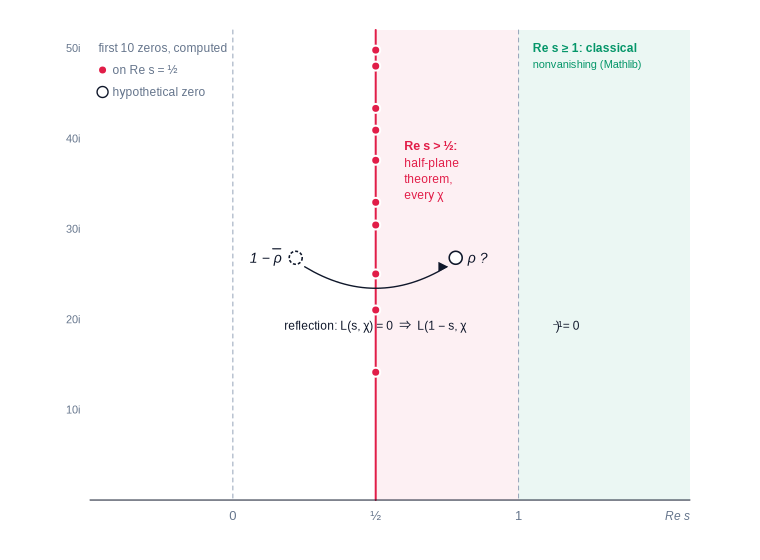
Fig. 2 Critical strip, reflection and the half-plane theorem. Schematic plane with the computed first zeta zeros on the critical line; a hypothetical off-line zero rho and its mirror image 1 - conj(rho) under the functional equation.#
Lean declaration (archive, pinned at the mirror commit) |
Note |
|---|---|
type: RiemannHypothesis (Mathlib) |
|
the same statement, quantifiers written out |
|
half-plane nonvanishing, all characters |
|
critical-strip zeros, all characters |
|
critical-strip zeros, primitive characters |
|
Mathlib 0df444a3 |
Verification. ✓✓ Checked by two kernels Accepted by two independent proof checkers in runs of the reading project: a Lean replay or verified-mode comparison, and the Rust kernel NanoDA. The ledger names the runs and their receipts.
Status in the imported record (20 November 2026, 23:51 UTC). Two independent kernels accepted the complete proof, and all five theorems matched the canonical Mathlib challenge. Andrew Sutherland and Simon DeDeo each report independently building and replaying all 175,187 original modules with Lean 4.33.1. DeDeo reports zero errors and crashes. Sutherland additionally records a con-leche comparison of the five targets and a lean4lean check of every original module. Five modules required higher reduction limits. The individual logs identify the names, flags and successful reruns. (Status recorded by the reading project at 2026-11-20 23:51 UTC.)
What remains to check. What machine checking cannot settle: that the five Lean statements say what is meant (they are compared with an independently written Mathlib challenge), the soundness of the checkers and of Mathlib’s definitions, and the mathematical community’s own reading of the argument.
Blueprint. 13 of the reading project’s declarations belong to this component (5 checked by two kernels, 8 source-read); see 1 · The five endpoints.
Receives from 2 · Reflection: critical line (Claim.zeta · Claim.strip).
Verified cuts: this component lies outside both machine-checked implications (see The two verified cuts).
Announcement entries: 20 (16 Nov: Dirichlet GRH) — see The announcement’s twenty entries.
What exactly is exported#
The archive’s Main.lean exports five theorems. Their contracts, as recorded in the reading
project’s blueprint, are:
Declaration |
Contract |
Tier |
|---|---|---|
Every nontrivial zeta zero distinct from the pole has real part one half. |
✓✓ Checked by two kernels |
|
Every zero other than the negative even integers and the point one has real part one half. |
✓✓ Checked by two kernels |
|
For all positive moduli and all characters, L(s,χ) is nonzero for Re(s)>1/2, excluding the principal pole. |
✓✓ Checked by two kernels |
|
For every character of positive modulus, any zero with 0<Re(s)<1 satisfies Re(s)=1/2. |
✓✓ Checked by two kernels |
|
For every primitive character of positive modulus, all zeros in the open critical strip have real part one half. |
✓✓ Checked by two kernels |
Three conventions matter when one compares these types with the classical statements.
Total functions. Lean’s
riemannZetaandDirichletCharacter.LFunctionare total functions on \(\mathbb C\); at the pole they take some value. Mathlib’sRiemannHypothesistherefore excludes \(s=1\) explicitly, and the half-plane statement excludes the single pair \((\chi,s)=(\mathbf 1_N,1)\). Mathlib’s value of the totalized \(\zeta\) at \(s=1\) is \((\gamma-\log 4\pi)/2\), which it proves to be nonzero (Mathlib, pinned); that is why the archive’s primitive predicateZeroFreeAllcan include \(s=1\) for the character of modulus one without any exception.Trivial zeros. The negative even integers are actual zeros of \(\zeta\) and are excluded; \(\zeta(0)=-\tfrac12\neq0\).
The open strip. The all-character critical-line statement quantifies over \(0<\Re s<1\), and the strict left inequality is necessary: for the principal character modulo \(2\), \(L(s,\mathbf 1_2)=(1-2^{-s})\zeta(s)\) vanishes at \(s=2\pi i k/\log 2\) for every integer \(k\neq0\), on the line \(\Re s=0\), and also at \(s=0\).
Matching these types with the classical statements is a matter of reading definitions, and the three conventions above are the whole difference. The announcement’s further expectation about other \(L\)-functions has no endpoint in the archive.
2 · Reflection#
The destination ✓ Kernel-checked at the archive pin functional equations
The gist
A zero left of the critical line reflects to a zero right of it, so the right half-plane is all one has to clear.
Statement (paraphrase of the archive’s Lean statements in standard notation):
For zeta, put \(w=1-s\) with \(\operatorname{Re}w>\tfrac12\). The power and Gamma factors do not vanish, and a zero of the cosine would make \(s\) an even integer, i.e. \(0\) or a trivial zero. Hence a nontrivial zero on the left gives a zero on the right.
For a primitive character the completed functional equation sends a strip zero at \(s\) to a zero of \(L(\cdot,\chi^{-1})\) at \(1-s\); the Gamma factors are regular and nonzero for \(0<\operatorname{Re}s<1\). Taking \(\chi^{-1}\) matters when \(\chi\) is complex.
Fig. 3 Critical strip, reflection and the half-plane theorem. Schematic plane with the computed first zeta zeros on the critical line; a hypothetical off-line zero rho and its mirror image 1 - conj(rho) under the functional equation.#
Lean declaration (archive, pinned at the mirror commit) |
Note |
|---|---|
reflect a zeta zero |
|
transfer a primitive zero to 1 − s |
|
half-plane ⇒ critical-strip zeros on the line |
|
half-plane ⇒ the zeta statement |
|
Gamma factors do not vanish in the strip |
Verification. ✓ Kernel-checked at the archive pin Named declarations passed type, transitive-axiom (only propext, Classical.choice, Quot.sound) and kernel-replay checks at Lean 4.33.1.
Status in the imported record (20 November 2026, 23:51 UTC). Claim.strip, Claim.zeta and Formalism.VW.rh_of_right passed type, axiom and kernel checks at Lean 4.33.1 (Helios job 26639692).
What remains to check. None for the deduction itself; it is classical and machine-checked.
Blueprint. 8 of the reading project’s declarations belong to this component (3 kernel-checked at the archive pin, 1 inside a checked closure, 4 source-read); see 2 · Reflection.
Receives from 3 · Conductor descent: every χ, Re s > ½ (UpperTheory.Top.imprimitive).
Delivers to 1 · The five endpoints: critical line (Claim.zeta · Claim.strip).
Verified cuts through this component: One-sided prime windows imply RH and TopG and the cohomological windows imply RH and Dirichlet GRH.
The two functional equations in use#
For \(\zeta\) the archive’s deduction Formalism.VW.rh_of_right uses the asymmetric form
If \(\zeta(s)=0\) with \(\Re s<\tfrac12\), then \(\Re w>\tfrac12\); the factors \((2\pi)^{-w}\) and \(\Gamma(w)\) do not vanish, and \(\cos(\pi w/2)=0\) forces \(w\) to be an odd integer, i.e. \(s\) an even integer \(\le 0\) — the excluded trivial zeros or \(s=0\), where \(\zeta(0)\neq0\). Hence \(\zeta(w)=0\) with \(\Re w>\tfrac12\), which the half-plane statement forbids. (The archive also contains a second route through Mathlib’s completed zeta function; the two zeta exports use the first.)
For a primitive character \(\chi\) modulo \(q\) with parity \(\mathfrak a\in\{0,1\}\), put \(\Lambda(s,\chi)=(q/\pi)^{(s+\mathfrak a)/2}\,\Gamma\big(\tfrac{s+\mathfrak a}2\big)L(s,\chi)\). Then
In the open strip the Gamma factor is finite and nonzero, so a zero of \(L(s,\chi)\) at \(\rho\) gives a
zero of \(L(s,\bar\chi)\) at \(1-\rho\). The archive’s Claim.prim_reflect records exactly this, with
\(\bar\chi=\chi^{-1}\). The inverse matters when \(\chi\) is complex: the reflected zero belongs to a
different \(L\)-function, which is why the half-plane statement must hold for all characters at
once (or at least for a set closed under inversion).
The deduction, abstractly#
The logical skeleton is a trichotomy argument: a zero in the strip lies left of, on, or right of
the critical line; on the right it contradicts the half-plane statement directly, on the left its
reflection does. This repository’s Lean skeleton states it over abstract types
(Atlas.strip_of_halfPlane, Atlas.rh_of_halfPlane), with the analytic facts as fields of a
structure Reflection; the build reports both theorems as depending on no axioms at all (see
The skeleton: Atlas/Architecture.lean).
3 · Conductor descent#
The destination ✓ Kernel-checked at the archive pin Euler factors
The gist
An imprimitive character differs from its primitive inducing character by finitely many Euler factors, none of which vanishes for \(\operatorname{Re}s>0\).
Statement (paraphrase of the archive’s Lean statements in standard notation):
Primes dividing the conductor have \(\chi^*(p)=0\); for the others the second term of the factor has modulus less than one. So nonvanishing passes from primitive characters to all characters, with the single exception of the principal character’s pole at \(s=1\).
The strict left boundary of the strip matters: \(1-2^{-s}\) vanishes on \(\operatorname{Re}s=0\), so \(L(s,\mathbf 1_2)=(1-2^{-s})\zeta(s)\) has extra zeros on the imaginary axis.
Lean declaration (archive, pinned at the mirror commit) |
Note |
|---|---|
primitive ⇒ all characters |
|
remove the imprimitive Euler factors |
|
a removed Euler factor is nonzero |
Verification. ✓ Kernel-checked at the archive pin Named declarations passed type, transitive-axiom (only propext, Classical.choice, Quot.sound) and kernel-replay checks at Lean 4.33.1.
Status in the imported record (20 November 2026, 23:51 UTC). UpperTheory.Top.imprimitive passed its type, axiom and defining-module checks in the 1,421-module Dirichlet closure (Helios job 26647685).
What remains to check. None for the deduction; classical and machine-checked.
Blueprint. 4 of the reading project’s declarations belong to this component (1 kernel-checked at the archive pin, 2 inside a checked closure, 1 source-read); see 3 · Conductor descent.
Receives from 7 · The order of choices: ZeroFreeAll (primitive) (zeroFreeAll_of_topG).
Delivers to 2 · Reflection: every χ, Re s > ½ (UpperTheory.Top.imprimitive).
Verified cuts through this component: TopG and the cohomological windows imply RH and Dirichlet GRH.
Why finitely many Euler factors are harmless#
Let \(\chi\) be a character modulo \(N\) induced by the primitive \(\chi^*\) of conductor \(f\mid N\). Then
where only primes \(p\mid N\), \(p\nmid f\) contribute nontrivially. For \(\sigma=\Re s>0\) every factor is nonzero, since \(|\chi^*(p)p^{-s}|\le p^{-\sigma}<1\). So in \(\Re s>\tfrac12\) the zeros of \(L(s,\chi)\) and of \(L(s,\chi^*)\) coincide, and the half-plane statement for primitive characters implies it for all characters. The principal character is the one case where a pole intervenes: the level-change formula is used under the side condition \(\chi\neq\mathbf 1\) or \(s\neq1\), which is exactly the exception carried by the exported statement.
In the strip the same identity transports zeros down to the primitive character, where the
functional equation applies; this is the step Claim.prim_zero. The boundary example of the
previous section shows what the strict inequality \(\Re s>0\) protects: the factor \(1-2^{-s}\) has its
zeros on \(\Re s=0\).
How the destination is checked#
The archive’s deductions Formalism.VW.rh_of_right, Claim.strip, Claim.zeta and
UpperTheory.Top.imprimitive passed the reading project’s type, transitive-axiom and replay
checks at the archive’s toolchain; the imported statuses, with their scopes, are on the cards above. Independently, this repository mirrors them in an
axiom-free abstract form (Atlas.halfPlane_of_primitive, Atlas.strip_of_halfPlane,
Atlas.rh_of_halfPlane), quoted in The skeleton: Atlas/Architecture.lean. The abstract version is not a proof about
\(\zeta\): it shows which properties of \(\zeta\) and of the \(L\)-functions the closing deductions use,
and that nothing else is needed.