Map of the argument#
The argument has four strata. Read in the direction of the logic, the arithmetic supply produces families of arithmetic objects; the estimate turns them into an upper bound for a weighted prime sum on long windows; the analytic engine turns such bounds into zero-free half-planes; and the destination turns the half-plane theorem into the five exported statements. The chapters of this book take the reverse order, from the claimed theorems back to the input they need.
Stratum |
Components |
|---|---|
destination |
|
analytic engine |
4. The centered prime sum |
estimate |
8. The finite character comparison |
arithmetic supply |
11. The cohomological window |
The component graph#
The fourteen components and the 14 interfaces of the model, drawn from
data/model.json. Arrows point in the direction of the logic (supply at the top, the exported
theorems at the bottom); each box carries its verification tier, and the pills Z and D
mark the components through which the two machine-checked implications run. The two dashed arrows
are exactly the premises of the second cut; the premise of the first cut enters the window criterion
from outside the model’s interfaces (a bound for the zeta prime sum alone).
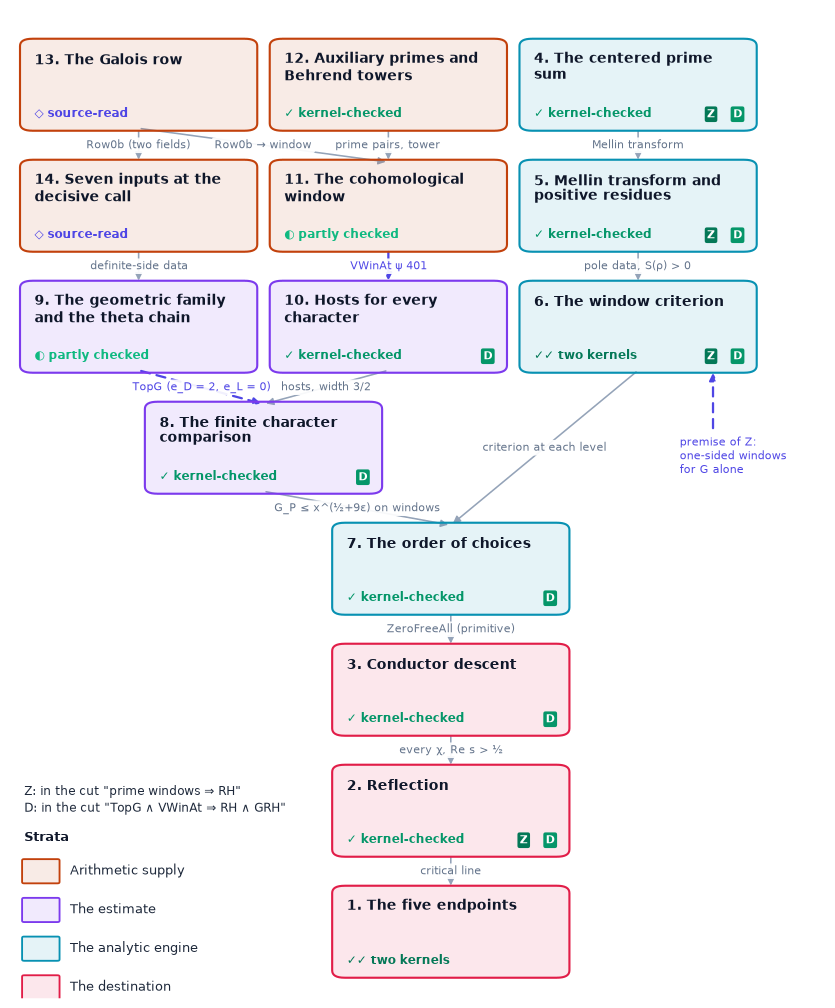
The fourteen components#
# |
Component |
Gist |
Stratum · tier |
|---|---|---|---|
1 |
Ordinary RH in Mathlib’s own formulation, and Dirichlet GRH for every character of every positive modulus. |
destination |
|
2 |
A zero left of the critical line reflects to a zero right of it, so the right half-plane is all one has to clear. |
destination |
|
3 |
An imprimitive character differs from its primitive inducing character by finitely many Euler factors, none of which vanishes for \(\operatorname{Re}s>0\). |
destination |
|
4 |
A ramp-weighted von Mangoldt sum, centered so that the main terms cancel exactly, and its positive combinations over a cyclic family of characters. |
analytic engine |
|
5 |
The Mellin transform of a ramp is \(n^{-s}/(s(s-1))\); a zero of any family member becomes a pole whose residue cannot be cancelled, because the weights are positive. |
analytic engine |
|
6 |
If a positive family’s prime sum stays below \(Cy^\theta\) throughout arbitrarily late windows \([Y,Y^{1+\delta}]\), none of its \(L\)-functions vanishes to the right of \(\theta\). |
analytic engine |
|
7 |
The loss exponents are fixed first; given a zero with \(\beta>\tfrac12\) choose \(\theta\in(\tfrac12,\beta)\), then \(\varepsilon\) with \(\tfrac12+9\varepsilon\le\theta\). No bound at \(\varepsilon=0\) is ever needed. |
analytic engine |
|
8 |
Finite Fourier orthogonality on a subgroup and an exact main-term identity convert a geometric discrepancy bound into the prime-sum bound, with exponent \(\tfrac12+(e_D+e_L+7)\varepsilon\). |
estimate |
|
9 |
A chain of about \(\sqrt x\) theta lifts, with divisibility, slope and covolume control, is chosen so that both loss exponents are fixed numbers: \(e_D=2\), \(e_L=0\). |
estimate |
|
10 |
For each primitive character \(\psi\), the cohomological window produces arithmetic hosts of width \(3/2\) at all large scales of a system of scales. |
estimate |
|
11 |
On a whole interval \([Y,Y^2]\), weighted lengths of locally trivial Galois cohomology of twisted modules are at most \(\sqrt{\exp(x^{\varepsilon})}\), uniformly over the relevant fields. |
arithmetic supply |
|
12 |
Two auxiliary primes with prescribed congruences and square-root prime-sum bounds for their quadratic twists, and an additive-combinatorial (Behrend) choice of the tower. |
arithmetic supply |
|
13 |
For regular algebraic polarized cuspidal \(\pi\) on \(\mathrm{GL}_a\) over a CM field, a continuous semisimple \(\ell\)-adic representation whose Frobenius polynomials match the Satake parameters of \(\pi\). |
arithmetic supply |
|
14 |
Unitary-group and local theta packages, agreement of theta integrals, local matching, a covolume bound, local Langlands parameters and the window: the seven arguments of the arithmetic theorem. |
arithmetic supply |
The interfaces#
Each interface is a proposition (or a structure) produced by one component and consumed by the next; the last column names the Lean declaration that realizes it in the archive.
From |
To |
What passes |
Lean |
|---|---|---|---|
13. The Galois row |
Row0b (two fields) |
|
|
13. The Galois row |
Row0b → window |
|
|
prime pairs, tower |
|
||
definite-side data |
|
||
VWinAt ψ 401 |
|
||
TopG (e_D = 2, e_L = 0) |
|
||
hosts, width 3/2 |
|
||
G_P ≤ x^(½+9ε) on windows |
|
||
Mellin transform |
|
||
pole data, S(ρ) > 0 |
|
||
criterion at each level |
|
||
ZeroFreeAll (primitive) |
|
||
2. Reflection |
every χ, Re s > ½ |
|
|
2. Reflection |
critical line |
|
The two verified cuts#
A cut is a Lean theorem, compiled against the original archive, whose hypotheses are exactly the inputs on one side of a line drawn through the component graph and whose conclusion is an endpoint. A cut certifies an implication. Its premise is not checked by it: the premise is precisely the part of the argument that remains to be supplied — in the archive, by the components on the other side of the line.
One-sided prime windows imply RH#
✓✓ Checked by two kernels Lean theorem Reading.WindowBridge.riemannHypothesis_of_prime_windows (source quoted in The archive bridges).
Premise — an explicit hypothesis of the checked theorem, not something the check establishes:
Conclusion. Mathlib’s RiemannHypothesis.
Components the implication runs through. 2. Reflection, 4. The centered prime sum, 5. Mellin transform and positive residues, 6. The window criterion.
Evidence. Fresh Lean replay over 10,530 modules (766,938 constants) and the independent Rust kernel NanoDA on 61,697 exported declarations; 31 original modules; axioms propext, Classical.choice, Quot.sound.
The family here is the singleton \(\{\zeta\}\) (the character of modulus one with weight one), so only 4 components are involved and no character other than the trivial one appears. The premise is equivalent to RH: under RH, Schoenfeld’s bound for \(\psi(x)-x\) gives \(|G(x)|\ll\sqrt x\,\log^2x\) for all large \(x\) (see How strong is the window condition?). The cut therefore does not make RH easier; it shows that the analytic engine and the closing reductions are correct and moves the whole difficulty into one explicit, one-sided estimate.
TopG and the cohomological windows imply RH and Dirichlet GRH#
✓ Kernel-checked at the archive pin Lean theorem Reading.DirichletBridge.endpoints_of_topG_vWin401 (source quoted in The archive bridges).
Premise — an explicit hypothesis of the checked theorem, not something the check establishes:
Conclusion. RH ∧ half-plane nonvanishing ∧ critical-strip zeros, for every positive modulus.
Components the implication runs through. 2. Reflection, 3. Conductor descent, 4. The centered prime sum, 5. Mellin transform and positive residues, 6. The window criterion, 7. The order of choices, 8. The finite character comparison, 10. Hosts for every character.
Evidence. 1,421 original modules at Lean 4.33.1; seven type/axiom reports; six defining modules replayed (Helios job 26647685).
This cut runs through 8 components and stops at two named propositions of the
archive: UpperTheory.Top.TopG, a statement about families of arithmetic data (its producer is
9 · The geometric family and the theta chain), and UpperTheory.Top.VWinAt ψ 401 for every primitive character \(\psi\), the
cohomological window (its producer is 11 · The cohomological window). Everything below the dashed arrows
of the component graph is machine-checked as an implication; everything above them — the theta
chain, the Galois row, the seven literature-shaped inputs, the producers of the cohomology bound —
lies outside both cuts. Its status is recorded component by component in The verification ledger:
mostly source-read, with some kernel-checked steps whose own premises are explicit, and all of it
inside the complete proof whose replays are listed there.
What the map shows and what it does not#
The arrows are the model’s interfaces, not the full dependency graph of the archive; the reading project’s map of 109 nodes is in The blueprint.
A component’s tier summarizes the evidence for its own deductions. A checked component may still consume an unchecked input; that input is then shown as a premise.
The five exported theorems carry no explicit arithmetic premise in their Lean types; whether the terms that discharge the premises are correct is what the replays of the complete proof and the open audit questions in The verification ledger are about.