The square-root balance and the exact staircase of losses#
This notebook redoes, in exact rational arithmetic, the exponent bookkeeping of the finite character comparison (8 · The finite character comparison): why the chain length is \(\sqrt x\), why the worst of the four budget terms costs \(x^{1/2+13\varepsilon/8}\), an explicit admissible choice of parameters that attains that term, and the staircase that ends at \(\tfrac12+(e_D+e_L+7)\varepsilon\).
Why \(\sqrt x\)#
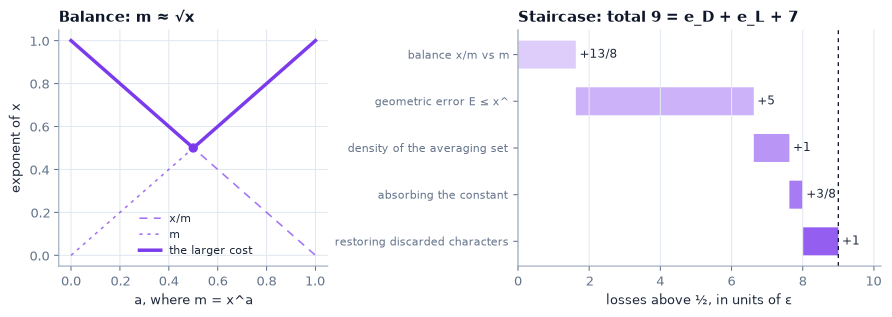
With \(m=x^a\) the two competing costs are \(x/m=x^{1-a}\) and \(m=x^a\). On a grid of exact rationals the larger exponent \(\max(1-a,a)\) is minimized at \(a=\tfrac12\), where both equal \(\tfrac12\):
grid = [F(j, 64) for j in range(65)]
best = min(grid, key=lambda a: max(1 - a, a))
print("argmin =", best, "  min =", max(1 - best, best))
assert best == F(1, 2) and rhlib.balance_exponent(float(best)) == 0.5
argmin = 1/2 min = 1/2
The four budget terms#
rhlib.budget_rows() encodes the four contributions to \(B/Q\) with exact exponents
\(\tfrac12\cdot[\text{half}]+(\text{eps})\cdot\varepsilon\), derived from the size hypotheses
\(a_E\le2xb\), \(n/u\le2x^{\varepsilon/8}\), \(x^{1/2-\varepsilon}\le m\le x^{1/2+\varepsilon/2}\),
\(xm\le k\le n^2x^{1/2-\varepsilon}\), \(v\le n\):
rows = rhlib.budget_rows()
for r in rows:
    expo = f"1/2 + {r['eps']}·ε" if r['half'] else "O(1)"
    print(f"{r['term']:<24} coefficient {r['coef']}   exponent {expo:<14} ({r['why']})")
worst = max(r['eps'] for r in rows if r['half'] == F(1, 2))
total_coef = sum(r['coef'] for r in rows)
print("worst ε-coefficient:", worst, "  sum of coefficients:", total_coef)
assert str(worst) == fb['worst_budget_eps'] and worst == F(1, 8) + F(1, 2) + 1
assert [r['coef'] for r in rows] == [b['coef'] for b in fb['budget']]
a_E/(m b)                coefficient 2   exponent 1/2 + 1·ε      (a_E/(mb) <= 2x/m and m >= x^{1/2-eps})
a_E m/(b k)              coefficient 2   exponent O(1)           (x m <= k)
2 (n/u) m x^eps          coefficient 4   exponent 1/2 + 13/8·ε   (n/u <= 2x^{eps/8}, m <= x^{1/2+eps/2}, the explicit x^eps)
(v/u)(k/n^2) x^{2 eps}   coefficient 2   exponent 1/2 + 9/8·ε    (v/u <= n/u <= 2x^{eps/8}, k/n^2 <= x^{1/2-eps}, the explicit x^{2eps})
worst ε-coefficient: 13/8   sum of coefficients: 10
The worst term is the third: \(\tfrac18\) from \(n/u\), \(\tfrac12\) from the upper bound on \(m\), and \(1\) from the explicit factor \(x^{\varepsilon}\).
An admissible example attaining the worst term#
Can all size hypotheses hold at once and the third term be as large as the bound allows? Take \(\varepsilon=\tfrac1{64}\), \(x=2^{1024}\), \(b=1\), \(a_E=2x\), and \(m,n,u,v,k\) powers of two with exponents \(520,524,521,508,1544\). Everything is a power of two, so all comparisons are exact comparisons of rational exponents of \(2\):
eps = F(1, 64)
X = F(1024)                                            # x = 2^X; below, every quantity is log2 of itself
lg = dict(m=F(520), n=F(524), u=F(521), v=F(508), k=F(1544), b=F(0), aE=1 + X)
xp = lambda e: X * e                                   # log2 of x^e

checks = {
    "a_E ≤ 2 x b":                  lg['aE'] <= 1 + X + lg['b'],
    "n/u ≤ 2 x^(ε/8)":              lg['n'] - lg['u'] <= 1 + xp(eps / 8),
    "x^(1/2−ε) ≤ m":                xp(F(1, 2) - eps) <= lg['m'],
    "m ≤ x^(1/2+ε/2)":              lg['m'] <= xp(F(1, 2) + eps / 2),
    "x m ≤ k":                      X + lg['m'] <= lg['k'],
    "k ≤ n² x^(1/2−ε)":             lg['k'] <= 2 * lg['n'] + xp(F(1, 2) - eps),
    "v ≤ n":                        lg['v'] <= lg['n'],
}
for name, ok in checks.items():
    print(f"{name:<20} {ok}")
assert all(checks.values())

terms = {
    "a_E/(m b)":               lg['aE'] - lg['m'] - lg['b'],
    "a_E m/(b k)":             lg['aE'] + lg['m'] - lg['b'] - lg['k'],
    "2 (n/u) m x^ε":           1 + lg['n'] - lg['u'] + lg['m'] + xp(eps),
    "(v/u)(k/n²) x^(2ε)":      lg['v'] - lg['u'] + lg['k'] - 2 * lg['n'] + xp(2 * eps),
}
bounds = {   # coefficient · x^(exponent) from the budget, as log2
    "a_E/(m b)":               1 + xp(F(1, 2) + 1 * eps),
    "a_E m/(b k)":             F(1),                   # the term is at most 2
    "2 (n/u) m x^ε":           2 + xp(F(1, 2) + F(13, 8) * eps),
    "(v/u)(k/n²) x^(2ε)":      1 + xp(F(1, 2) + F(9, 8) * eps),
}
for t in terms:
    print(f"{t:<22} = 2^{terms[t]}   bound 2^{bounds[t]}")
    assert terms[t] <= bounds[t]
assert terms["2 (n/u) m x^ε"] == bounds["2 (n/u) m x^ε"]
a_E ≤ 2 x b          True
n/u ≤ 2 x^(ε/8)      True
x^(1/2−ε) ≤ m        True
m ≤ x^(1/2+ε/2)      True
x m ≤ k              True
k ≤ n² x^(1/2−ε)     True
v ≤ n                True
a_E/(m b)              = 2^505   bound 2^529
a_E m/(b k)            = 2^1   bound 2^1
2 (n/u) m x^ε          = 2^540   bound 2^540
(v/u)(k/n²) x^(2ε)     = 2^515   bound 2^531
The four normalized terms are \(2^{505}\), \(2^{1}\), \(2^{540}\), \(2^{515}\), and the third, \(2^{540}\), equals \(4x^{1/2+13\varepsilon/8}\) exactly. So the exponent \(\tfrac{13}{8}\) is not an artefact of a lossy estimate: within the scalar hypotheses it can be reached. (The example tests the scalar calculation only; it says nothing about the existence of arithmetic hosts with these parameters.)
From the worst term to \(e_D+e_L+7\)#
With \(P=x^{C_*\varepsilon}\), \(C_*=e_D+e_L+3\), and \(Y=x^{1/2+13\varepsilon/8}\), the four coefficients add up to \(10\), so \(E/Q\le10PY\). The finite comparison \(Q\frac\delta2(G_\Lambda-\Sigma-4x^{1/2+\varepsilon})\le E+\frac{2Q}x\) and \(2/\delta\le2x^{\varepsilon}\) give
then \(26\le x^{3\varepsilon/8}\) gives \(G_\Lambda-\Sigma\le x^{1/2+(C_*+3)\varepsilon}\), and with \(\Sigma\le4o\,x^{1/2+\varepsilon}\) and \(1+4o\le x^{\varepsilon}\) finally \(G_\Lambda\le x^{1/2+(C_*+4)\varepsilon}=x^{1/2+(e_D+e_L+7)\varepsilon}\). In units of \(\varepsilon\):
eD, eL = fb['eD'], fb['eL']
Cstar = eD + eL + 3
steps = [(w, F(v)) for w, v in fb['steps']]
assert [v for _, v in steps] == [worst, F(Cstar), F(1), F(3, 8), F(1)]
acc = F(0)
for what, v in steps:
    acc += v
    print(f"+{str(v):>4}  → {str(acc):>5}   {what}")
assert acc == eD + eL + 7 == F(fb['total_eps'])
# the exponent C* + 21/8 of the intermediate bound, and the absorption of 26
assert worst + Cstar + 1 == Cstar + F(21, 8) and Cstar + F(21, 8) + F(3, 8) == Cstar + 3
assert 2 * 10 + 2 == 22 and 22 + 4 == 26 and sum(r['coef'] for r in rows) == 10
+13/8  →  13/8   balance x/m vs m (worst budget term)
+   5  →  53/8   geometric error E ≤ x^(C*·ε)·B with C* = e_D + e_L + 3
+   1  →  61/8   density of the averaging set: 2/δ ≤ 2·x^ε
+ 3/8  →     8   absorbing the constant: 26 ≤ x^(3ε/8)
+   1  →     9   restoring discarded characters: 1 + 4o ≤ x^ε
With the source’s \(e_D=\)2 and \(e_L=\)0 the total is 9: the comparison delivers \(G_\Lambda(x)\le x^{1/2+9\varepsilon}\), which is what the order of choices (7 · The order of choices) consumes.
How small must \(\varepsilon\) be?#
The order of choices takes \(\theta=\tfrac12+\tfrac12\min(\beta-\tfrac12,\tfrac12)\) for a putative zero with real part \(\beta\) and then any \(\varepsilon\le(\theta-\tfrac12)/9\):
for beta in (F(52, 100), F(6, 10), F(3, 4), F(1)):
    theta = F(1, 2) + F(1, 2) * min(beta - F(1, 2), F(1, 2))
    eps_max = (theta - F(1, 2)) / (eD + eL + 7)
    assert F(1, 2) < theta < min(beta, 1) or (beta == 1 and theta < 1)
    print(f"β = {str(beta):>6}:  θ = {str(theta):>7},  ε ≤ {eps_max}")
β =  13/25:  θ =  51/100,  ε ≤ 1/900
β =    3/5:  θ =   11/20,  ε ≤ 1/180
β =    3/4:  θ =     5/8,  ε ≤ 1/72
β =      1:  θ =     3/4,  ε ≤ 1/36
The chain length of the source fits the window#
RankVal puts \(m\) between \(\sqrt{x\delta_1}\) and \(2\sqrt{x\delta_1}\) with \(\delta_1=x^{-\varepsilon/8}\), i.e.
\(m\asymp x^{1/2-\varepsilon/16}\); the comparison demands \(x^{1/2-\varepsilon}\le m\le x^{1/2+\varepsilon/2}\).
For every \(\varepsilon>0\) the exponent \(\tfrac12-\tfrac{\varepsilon}{16}\) lies strictly inside, so the
factor \(2\) is absorbed once \(x\) is large:
for e in (F(1, 53), F(1, 100), F(1, 1000)):
    lo, mid, hi = F(1, 2) - e, F(1, 2) - e / 16, F(1, 2) + e / 2
    assert lo < mid < hi
    # 2 x^mid <= x^hi  <=>  x^(hi - mid) >= 2  <=>  x >= 2^(1/(hi - mid))
    print(f"ε = {e}:  {lo} < {mid} < {hi};  the factor 2 is absorbed for log2 x ≥ {1 / (hi - mid)}")
ε = 1/53:  51/106 < 423/848 < 27/53;  the factor 2 is absorbed for log2 x ≥ 848/9
ε = 1/100:  49/100 < 799/1600 < 101/200;  the factor 2 is absorbed for log2 x ≥ 1600/9
ε = 1/1000:  499/1000 < 7999/16000 < 1001/2000;  the factor 2 is absorbed for log2 x ≥ 16000/9