The architecture of the announced proof of the Riemann hypothesis#
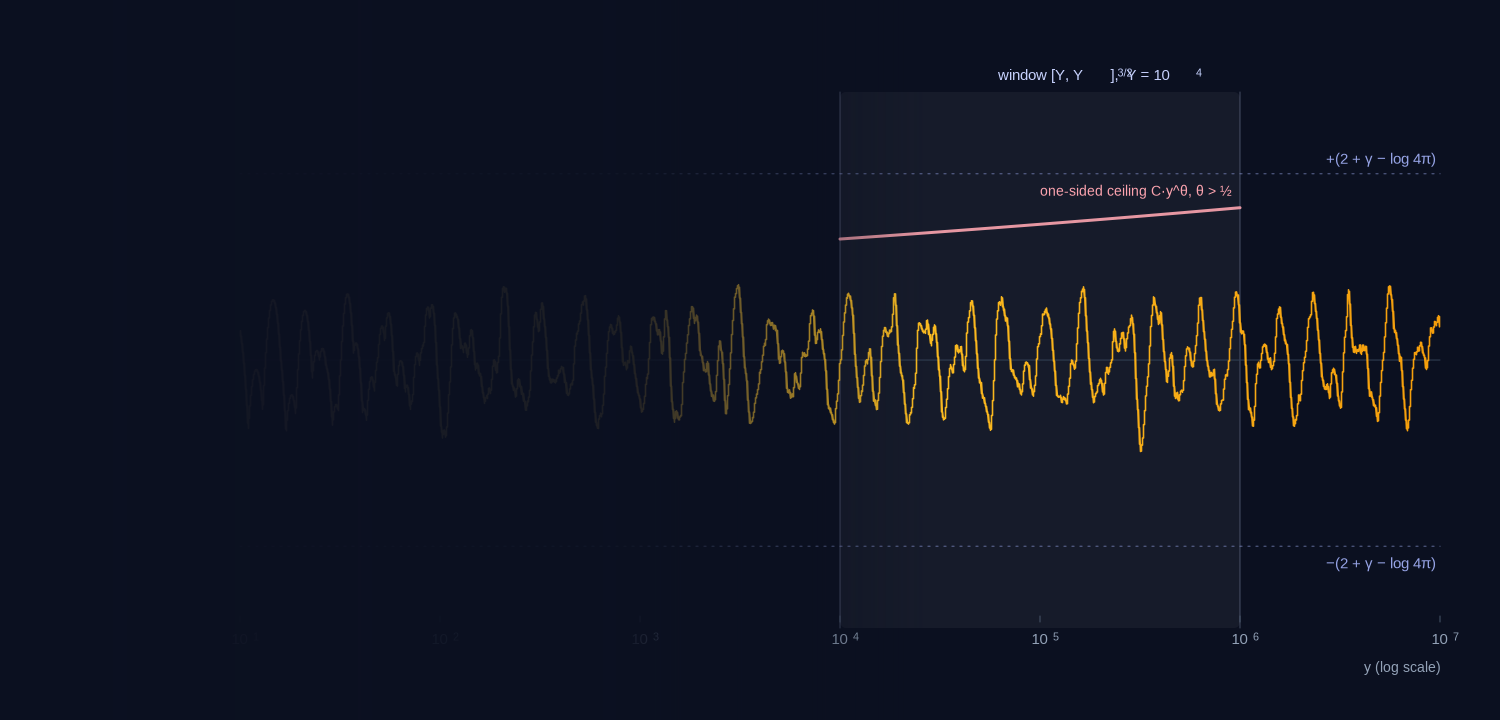
Fig. 1 The centered prime sum, normalized. Computed: (G(y) - log 2pi)/sqrt(y) for 10 <= y <= 10^7, where G(y) = sum_{n<=y} Lambda(n)(y/n-1) - y log y + (1+gamma) y. Dotted lines: +-(2+gamma-log 4pi), the band that RH forces. Shaded column: one power window [Y, Y^(3/2)], Y = 10^4, with an illustrative one-sided ceiling C y^theta (theta = 0.55) in the same normalization.#
On 20 November 2026 Levent Alpöge announced a proof of the Riemann hypothesis and of the generalized Riemann hypothesis for Dirichlet \(L\)-functions, accompanied by a Lean archive of 175,187 modules whose final theorems state these results in Mathlib’s own language. This book is an illustrated atlas and blueprint of the architecture of that argument, written for a mathematician who knows the zeta function and wants to see
the gist of each component of the argument in standard mathematical language,
how the components fit together,
precise, pinned links to the Lean declarations (all source links point to commit 40e56bab of the public mirror of the archive), and
exactly what has and has not been machine-checked, with time stamps.
The announcement is a claim. Nothing in this book asserts that the Riemann hypothesis has been proved. The book separates kernel-checked implications (whose premises remain hypotheses), source-read components, the recorded replays of the complete formal proof, and motivation; what a formal check does and does not establish is discussed in The verification ledger.
The announced argument in three sentences#
Analytic engine. If a centered, ramp-weighted sum over prime powers, taken for a positive combination of Dirichlet characters, is bounded from above by \(C\,y^{\theta}\) at every point of arbitrarily late windows \([Y, Y^{3/2}]\), then none of the corresponding \(L\)-functions vanishes in \(\Re s>\theta\); this localized Landau argument, and the classical reductions by conductor descent and the functional equation that turn such half-plane statements into the critical-line statements, are machine-checked.
The estimate. The archive claims such bounds with \(\theta=\tfrac12+9\varepsilon\) for every small \(\varepsilon>0\), by comparing the prime sum, through a finite character-orthogonality computation, with arithmetic data attached to a chain of about \(\sqrt x\) theta lifts — the square root is where two competing costs \(x/m\) and \(m\) balance.
Arithmetic supply. The chain, its hosts and the uniformity in \(\varepsilon\) are claimed to come from Galois representations attached to automorphic representations, auxiliary primes and Behrend sets, and a bound for Galois cohomology along cyclotomic towers; apart from a few kernel-checked steps these producers have been read at the source rather than replayed one by one; they are part of the complete proof, whose replays are recorded in The verification ledger.
Status — imported record of 20 November 2026, 23:51 UTC
The announcement is a claim; this book reports records and does not itself assert that the theorem is true. The five exported theorems carry the tier checked by two kernels: Accepted by two independent proof checkers in runs of the reading project: a Lean replay or verified-mode comparison, and the Rust kernel NanoDA. The ledger names the runs and their receipts. The reading project’s native checks of named declarations, and this repository’s own checks, establish implications whose premises are explicit. The tiers used on every page are explained in The verification ledger.
Headline of the reading project’s status record: “Two independent kernels accepted the complete proof, and all five theorems matched the canonical Mathlib challenge.”
Checked natively by the reading project: At Lean 4.33.1 we checked 24 named original results and 21 reading deductions across 2,244 distinct original modules. We also checked five endpoint equivalences and an Euler-factor boundary example. The one-sided prime-window implication passed fresh Lean replay with Mathlib and a second kernel on a portable proof of 61,697 declarations. The two-input deduction of ordinary RH and Dirichlet GRH, four steps from finite character comparison to the prime-sum bound and the auxiliary-prime theorem for three changing quadratic twists all passed. LemmaK, FixedIn and TwoIn yield one record of cohomological window constants for every cutoff exponent Ct ≥ 1. From Poitou–Tate duality, local finiteness and local Tate duality, a tower gives its cohomological bound. Adding Ferrero–Washington and LemmaK yields the joint window under those same hypotheses. Eight further teaching declarations use Lean 4.35.0. At each fixed primitive character, TopG and just its own cohomological estimate yield a cyclic-family bound with coefficient one. For the principal character modulo one this is the exact centered ordinary prime sum. The archive supplies the ordinary first moment unconditionally. Fresh kernel replay establishes that Schoenfeld’s RH-to-Chebyshev estimate suffices for the converse from RH to the window bound.
External reports, as summarized by the reading project (external reports as recorded: 23:00 UTC): Andrew Sutherland and Simon DeDeo each report independently building and replaying all 175,187 original modules with Lean 4.33.1. DeDeo reports zero errors and crashes. Sutherland additionally records a con-leche comparison of the five targets and a lean4lean check of every original module. Five modules required higher reduction limits. The individual logs identify the names, flags and successful reruns. Sources: Sutherland’s five named con-leche results · Sutherland’s five raised-fuel lean4lean reruns · Full solution and dated operator report · Second complete original-toolchain replay · Five individual axiom lists · Rust process log · Download checksums · Earlier challenge comparison · Independent five-target comparison · Independent rebuild with a separately generated proof export
How to read this book#
Ten minutes. Read Map of the argument: the four strata, the fourteen components, the interfaces between them, and the two machine-checked implications (“cuts”) with their premises.
The mathematics. The chapters The destination: from a half-plane to the five endpoints, The analytic engine: from one-sided windows to a zero-free half-plane, The estimate: from a chain of theta lifts to a prime-sum bound and The arithmetic supply follow the argument backwards, from the five exported theorems to the arithmetic input. Every component section opens with a generated card (gist, statement, explanation, figure, pinned Lean declarations, verification tier, what remains to check) followed by a more detailed mathematical discussion.
The computations. Five executed notebooks recompute what the figures show: the explicit formula behind the centered prime sum, the spotlight kernel of the window criterion, the exact exponent budget, the interval lemma and ultrametric separation, and a Behrend digit sphere.
The formal record. The Lean library and the archive bridges quotes this repository’s compilable Lean skeleton and the archive bridges; The blueprint lists all 107 declarations of the reading project’s map; The verification ledger is the ledger of what was checked, by whom, and when; The announcement’s twenty entries maps the announcement’s twenty dated entries to the components.
The reading project proposes 5 itineraries through the blueprint:
Read the last page of the proof first. How does a right-half-plane estimate imply ordinary RH? (4 steps, from “Mathlib RH” to “Reflect a zeta zero”; see Itineraries.)
Find the mathematical estimate. How wide must the intervals be, and where does the loss in the exponent come from? (6 steps, from “Produce primitive zero-free levels” to “Combine divisibility, slopes and windows”; see Itineraries.)
Find who supplies the arithmetic. Which assertion has to produce the compatible Galois, theta and cohomology data? (7 steps, from “Closed half-plane assembly” to “Produce the four counting bounds”; see Itineraries.)
Follow a singular twist and an arbitrary finite prime sum. Which bound controls a twist of unbounded abstract length, and how can one estimate work over every allowed finite set of coefficient primes? (14 steps, from “Produce the four counting bounds” to “Bound the sum over arbitrary finite sets of other primes”; see Itineraries.)
Recover the centering constant in the ordinary zeta window. Why is the linear correction (1+γ)x? (6 steps, from “The first moment of the Chebyshev error” to “Read Euler’s constant from the logarithmic derivative”; see Itineraries.)
Companions#
Companion |
Where |
|---|---|
Interactive atlas: master map, blueprint graph with Lean links, ideas, ledger |
open the atlas (722,332 bytes, single self-contained file) |
Illustrated PDF blueprint |
|
Compilable Lean library (no imports) |
The Lean library and the archive bridges — |
Computed figures |
13 SVG files in |
Conventions#
Tier |
Meaning |
Components |
Blueprint nodes |
|---|---|---|---|
✓✓ two kernels |
Accepted by two independent proof checkers in runs of the reading project: a Lean replay or verified-mode comparison, and the Rust kernel NanoDA. The ledger names the runs and their receipts. |
2 |
5 |
✓ kernel-checked |
Named declarations passed type, transitive-axiom (only propext, Classical.choice, Quot.sound) and kernel-replay checks at Lean 4.33.1. |
8 |
18 |
◐ partly checked |
Some of the component’s named declarations are kernel-checked; the producers of its remaining inputs are source-read. |
2 |
0 |
⊂ in checked closure |
Called (directly or transitively) by a kernel-checked declaration, so it was elaborated and kernel-checked as part of that closure and its axioms are within that declaration’s report. For a definition this only means that it typechecks: a proposition it defines (for instance VWinAt) can still be a hypothesis. |
0 |
19 |
◇ source-read |
Statement and proof term located at pinned source lines and read; not replayed as a named declaration by the reading project’s audit. It is part of the complete proof, whose replays are listed in the ledger. |
2 |
65 |
↗ replay reported |
Checked in a full replay of the archive reported by an external builder; the reading project has not (yet) recorded a run of its own for it. |
0 |
0 |
○ motivation |
A heuristic or historical idea from the announcement; no theorem is attached to it. |
0 |
2 |
Stratum colours follow the atlas: the destination, the analytic engine, the estimate and the
arithmetic supply. Numbers on every page are recomputed or read from the repository’s data files
when the book is built; hidden assertions stop the build if a quoted number disagrees with
data/model.json, assets/figures/facts.json or verification/logs/axioms.json. The data of
the reading project were imported with SHA-256 checksums (see Sources, pins and references); its status record
is quoted with its time stamp (20 November 2026, 23:51 UTC) and later developments are not reflected here
until the next import.